
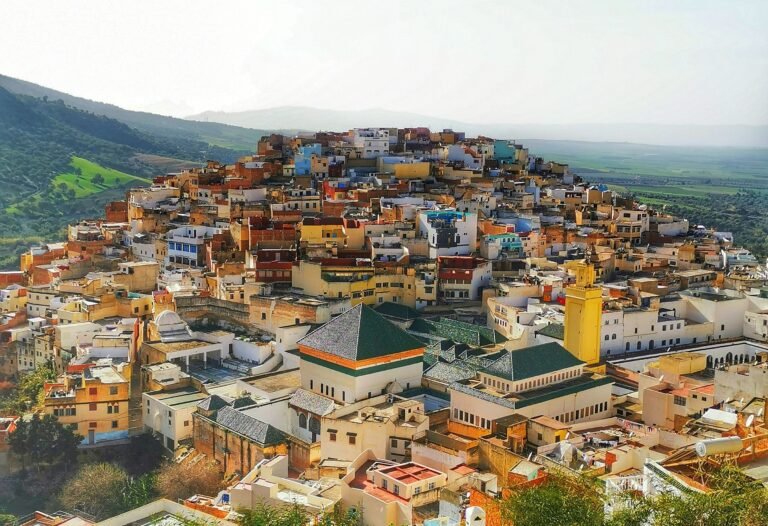
Meknes Morocco: Discover the Imperial City of Moulay Ismail
When travelers think about Morocco’s imperial cities, Marrakech and Fes often come to mind first. But between them lies another fascinating city with a rich history, impressive architecture and a much more relaxed atmosphere: Meknes Morocco.
Meknes is one of Morocco’s four imperial cities and was once the powerful capital of Sultan Moulay Ismail. Its historic medina, monumental gates, royal buildings and nearby Roman ruins make it a destination full of stories.
What makes Meknes particularly enjoyable is that you can experience much of its history simply by walking through the old city. Around one corner you might find a centuries-old gate, and around another, a quiet street filled with small shops and local life.
For travelers interested in history and culture, Meknes deserves a place on a Morocco itinerary.
Where Is Meknes?
Meknes is located in northern Morocco, between Rabat and Fes, in the fertile Saïss region.
Its location has historically been important because it sits close to major agricultural areas and important routes connecting different parts of the country.
The city is also close to Volubilis, one of Morocco’s most important archaeological sites, making Meknes an excellent base for discovering both Islamic and Roman history.
The surrounding countryside is known for fertile farmland, olive trees and vineyards, giving the region a greener appearance than many parts of southern Morocco.
A Brief History of Meknes
The history of Meknes goes back many centuries, but the city became particularly important during the reign of Sultan Moulay Ismail, who ruled Morocco from 1672 to 1727.
Moulay Ismail chose Meknes as his capital and transformed the city on a grand scale.
He ordered the construction of enormous walls, gates, palaces, granaries, gardens and other royal structures.
His vision was to create a powerful imperial capital, and many of the monuments visitors see today are connected to this period.
Walking through Meknes today gives you a sense of that ambition.
The enormous walls surrounding the old city and the monumental gates are reminders of a time when Meknes was at the center of Moroccan political life.
Bab Mansour: The Famous Gate of Meknes
One of the most recognizable landmarks in Meknes Morocco is Bab Mansour.
The monumental gate stands near the old imperial city and is famous for its impressive proportions and detailed decoration.
Its traditional Moroccan architecture combines intricate tilework, carved surfaces and large arched forms.
For many visitors, Bab Mansour is the first image that comes to mind when they hear the name Meknes.
It is also a wonderful place to begin exploring the historic part of the city.
Rather than simply taking a photograph and moving on, take some time to look at the details. The craftsmanship reflects the importance of architecture during the reign of Moulay Ismail.
The Medina of Meknes
The Meknes medina is where the city feels most alive.
Walking through its narrow streets, you can discover traditional shops, small cafés, artisans and everyday scenes that have remained part of Moroccan urban life for generations.
Compared with the medinas of Marrakech and Fes, Meknes often feels less overwhelming.
That can be a major advantage for travelers who want to explore at their own pace.
You can wander without constantly feeling that you are surrounded by large groups of tourists.
The best way to experience the medina is to slow down. Look at the traditional doors, notice the architecture, stop for Moroccan tea and allow yourself to get a little lost.
Sometimes the most interesting discoveries are found away from the main monuments.
Moulay Ismail and His Imperial City
The story of Meknes cannot be separated from Sultan Moulay Ismail.
His reign left an enormous architectural mark on the city.
The imperial area included palaces, gardens, storage buildings, stables and other structures connected with the royal court.
Some parts have survived better than others, but together they demonstrate the scale of the project.
Moulay Ismail wanted Meknes to become a powerful imperial capital, and the city’s monumental architecture still reflects that ambition.
Heri es-Souani: The Royal Granaries
Among the most impressive structures associated with Moulay Ismail are the Heri es-Souani.
These enormous buildings were used for storing grain and other supplies.
Their thick walls and carefully designed spaces were adapted to the climate, helping keep the interior relatively cool.
The complex is particularly interesting because it shows that the architecture of imperial Meknes was not only about decoration.
It was also about organization, storage and supporting a large royal city.
The Royal Stables
Near the granaries are the remains traditionally associated with the royal stables.
The scale of the structures gives visitors an idea of how important horses were to the royal court and military during Moulay Ismail’s period.
Even in their current state, the enormous spaces are impressive.
They are another example of how Meknes was designed on a much larger scale than an ordinary Moroccan city.
Mausoleum of Moulay Ismail
The Mausoleum of Moulay Ismail is another important historic site in Meknes.
The complex is associated with the sultan who transformed the city into his imperial capital.
Its architecture includes courtyards, traditional Moroccan decoration and beautifully crafted details.
For visitors interested in Moroccan history, the mausoleum provides a more personal connection to the ruler whose legacy is visible throughout Meknes.
As with religious and sacred sites throughout Morocco, visitors should always respect local rules concerning access and appropriate behavior.
Place El Hedim
Another important place to experience in Meknes is Place El Hedim, located in front of Bab Mansour.
The square provides a meeting point between the historic medina and the imperial part of the city.
It is a good place to sit, have a drink and watch everyday life unfold.
The atmosphere changes during the day, and the square becomes particularly lively toward the evening.
For travelers who enjoy observing local life rather than simply visiting monuments, this can be one of the most enjoyable stops in Meknes.
Volubilis: Roman History Near Meknes
One of the biggest advantages of visiting Meknes is its proximity to Volubilis.
Located in the surrounding countryside, Volubilis is an ancient Roman archaeological site and one of the most important historical attractions in Morocco.
Walking among the ruins, columns and mosaics gives you a completely different perspective on Moroccan history.
The site reminds visitors that the history of Morocco goes far beyond the Islamic and Arab-Amazigh heritage that is more visible in the country’s medinas.
Roman influence was once significant in this part of North Africa, and the remains at Volubilis provide an extraordinary glimpse into that ancient world.
The countryside surrounding the ruins is also beautiful, particularly when the fields are green.
Meknes and Moulay Idriss
Another interesting destination near Meknes is Moulay Idriss Zerhoun, a small town built among hills.
It is an important pilgrimage destination in Morocco and is associated with Moulay Idriss I, considered the founder of the Idrisid dynasty.
The town’s position among the hills makes it visually striking.
Combining Meknes with Volubilis and Moulay Idriss can provide a fascinating day of history, architecture and countryside.
What to Eat in Meknes
A visit to Meknes would not be complete without trying some Moroccan food.
You can find traditional dishes such as:
- Tagine
- Couscous
- Harira
- Moroccan salads
- Pastilla
- Fresh bread
- Mint tea
The city and surrounding region are also associated with agriculture, particularly olives and other local produce.
One of the pleasures of traveling through Morocco is discovering how food changes slightly from one region to another.
Don’t be afraid to eat where local people eat. A simple meal in a small restaurant can sometimes become one of the most memorable moments of your trip.
Things to Do in Meknes
There are plenty of ways to experience the city.
Explore Bab Mansour
Admire one of Morocco’s most impressive historic gates and photograph its detailed architecture.
Walk Through the Medina
Take your time exploring the narrow streets, traditional shops and local markets.
Visit the Imperial Heritage
Discover the buildings and monuments connected with Sultan Moulay Ismail.
See Heri es-Souani
Explore the enormous royal granaries and learn about how the imperial city was supplied.
Relax at Place El Hedim
Sit down with a Moroccan tea and watch the rhythm of everyday life around the square.
Visit Volubilis
Discover Roman ruins, ancient columns and beautiful mosaics in the countryside outside Meknes.
Explore Moulay Idriss
Visit the historic pilgrimage town and enjoy its hilltop views and traditional atmosphere.
The Best Time to Visit Meknes
Meknes can be visited throughout the year, but spring and autumn are particularly pleasant for exploring the city on foot.
Spring brings greener landscapes to the surrounding countryside, while autumn generally offers comfortable temperatures for sightseeing.
Summer can be hot during the middle of the day, so early mornings and late afternoons are often more comfortable for walking.
Winter is generally cooler and can bring rain, but it can also be a quieter period for exploring the medina and historic monuments.
How Long Should You Spend in Meknes?
You can experience the main highlights of Meknes in a day, particularly if you combine the city with Volubilis.
However, spending more time allows you to explore without rushing.
Meknes is a city that rewards slow travel.
Rather than checking monuments off a list, take time to walk through the medina, sit in a square, talk with local people and appreciate the architecture.
You may discover that the quieter moments are the ones you remember most.
Why Visit Meknes?
Meknes doesn’t always receive the same attention as Marrakech or Fes, and that may actually be part of its charm.
It offers impressive imperial architecture without the same level of tourist crowds found in some of Morocco’s more famous destinations.
Its history is fascinating, its medina is authentic and its location makes it easy to combine with Volubilis and other destinations in northern Morocco.
For travelers who want to understand Morocco beyond the most famous attractions, Meknes is well worth discovering.
From Meknes to the Sahara: Discovering More of Morocco
Meknes can also be part of a much larger Moroccan journey.
Travelers continuing south can discover Fes, the Middle Atlas Mountains, the Ziz Valley and eventually the Sahara Desert around Merzouga.
The landscapes change dramatically along the way.
The green and fertile areas around northern Morocco gradually give way to mountains, valleys and the dry landscapes of southeastern Morocco before the golden dunes of Erg Chebbi appear.
This is one of the reasons a journey through Morocco can be so rewarding: the country is not one single landscape, but many different worlds connected by roads, history and culture.
Discover Meknes with Sahara Desert Crew
At Sahara Desert Crew, we believe that Morocco is best experienced by taking time to discover the places between the major destinations.
Meknes can be an excellent addition to a private Morocco journey, especially for travelers interested in history, architecture and local culture.
Depending on your travel plans, a Morocco tour can connect Meknes and Fes with the Middle Atlas, desert landscapes and the Sahara, creating a journey that combines imperial cities with mountains, valleys and desert scenery.
Our approach is to keep tours comfortable but authentic, with private transportation and flexibility to spend more time in the places that interest you most.
Meknes may not always be the first city travelers think of when planning Morocco, but once you walk through its historic streets and stand in front of its monumental gates, it is easy to understand why this former imperial capital deserves a place on the map.
Frequently Asked Questions About Meknes Morocco
Is Meknes worth visiting?
Yes. Meknes is an excellent destination for travelers interested in Moroccan history, architecture, traditional medinas and the heritage of Sultan Moulay Ismail.
What is Meknes famous for?
Meknes is famous for its imperial history, Bab Mansour, the historic medina, Moulay Ismail’s monuments and its proximity to the Roman ruins of Volubilis.
What are the best things to do in Meknes?
Some of the highlights include exploring Bab Mansour, walking through the medina, visiting Heri es-Souani, discovering the imperial monuments, relaxing at Place El Hedim and visiting nearby Volubilis.
Is Meknes close to Fes?
Yes. Meknes and Fes are relatively close to each other, making it practical to visit both cities during the same Morocco trip.
Can I visit Volubilis from Meknes?
Yes. Volubilis is located near Meknes and is commonly visited as part of a day exploring the historical sites around the city.
Who was Moulay Ismail?
Moulay Ismail was a Moroccan sultan who ruled from 1672 to 1727. He made Meknes his capital and oversaw major construction projects that shaped the city.
How many days do you need in Meknes?
One full day can cover the main attractions, but spending longer allows you to explore the medina and surrounding sites at a more relaxed pace.
Can Meknes be combined with a Sahara Desert tour?
Yes. Meknes can be combined with Fes, the Middle Atlas Mountains and a journey toward the Sahara, depending on the route and available time.