
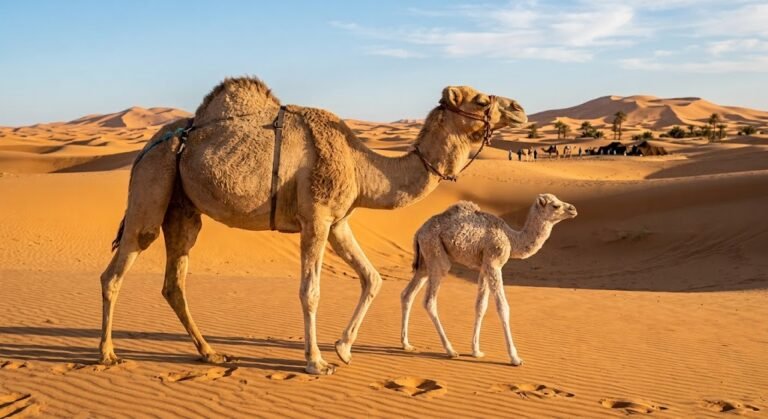
Camel Life in the Sahara Desert
When you see a camel slowly walking across the golden dunes of the Sahara, it can seem as if the animal was made for the desert.
The heat can be intense, water may be far away, and vegetation can be difficult to find. Yet camels have been living and traveling through these harsh environments for centuries.
In Morocco, the dromedary camel, with its single hump, is closely connected to desert life. For generations, camels have helped nomadic communities transport people and belongings across the Sahara.
Today, they are also an important part of the Moroccan desert experience, especially around Merzouga, Erg Chebbi and Chegaga.
How Does a Camel Survive in the Desert?
Camels have some incredible natural adaptations.
Their hump does not store water. Instead, it stores fat, which provides energy when food is difficult to find.
Their wide, padded feet help them walk over soft sand without sinking deeply. Their long legs keep their bodies away from the hottest part of the ground.
Camels are also extremely efficient at conserving water. They can tolerate significant dehydration and, when water becomes available, can drink a large amount in a short time.
Their ability to survive with limited food and water makes them perfectly suited to desert environments.
What Do Camels Eat?
The Sahara may look empty, but camels can find food in places where many animals would struggle.
They eat grasses, shrubs, thorny plants and other desert vegetation. Their tough mouths allow them to eat plants with thorns and rough leaves.
A camel does not need a green pasture to survive. It can make use of the small amount of vegetation available in the desert.
Camel Pregnancy and Baby Camels
Camel reproduction is another fascinating part of camel life.
A female dromedary camel has a pregnancy of approximately 12 to 14 months, usually around 13 months.
Normally, she gives birth to one calf, although twins can occur very rarely.
When a baby camel is born, it is already relatively well developed. It can stand and begin walking within a short time after birth.
The mother will care for her calf and provide milk while it grows stronger.
Watching a mother camel with her young is a beautiful reminder that these animals have their own family lives beyond the tourist experience.
How Long Do Camels Live?
A healthy dromedary camel can live for approximately 40 to 50 years, although lifespan depends on factors such as health, nutrition, environment and care.
That means a camel can remain part of a desert community for many years.
Experienced camel owners often know their animals very well. They recognize their personalities, habits and individual behavior.
Some camels are calm and patient, while others can be surprisingly stubborn!
Camels and Nomadic Life
Before modern roads and vehicles connected remote parts of the Sahara, camels were essential for desert travel.
Nomadic families relied on them to carry tents, food and other belongings while moving between grazing areas and water sources.
The camel was much more than transportation. It was part of everyday desert life.
This relationship between people and camels has continued into modern Morocco.
Experiencing Camel Life in Merzouga
For travelers, one of the best ways to appreciate the camel’s relationship with the Sahara is to take a camel trek in Merzouga.
As the camel walks slowly through the Erg Chebbi dunes, you have time to appreciate the silence, the changing colors of the sand and the enormous desert landscape.
Many travelers choose a sunset camel ride followed by a night in a Sahara desert camp.
It is easy to focus on the photographs, but there is a deeper story behind the experience.
For centuries, camels have crossed these same desert landscapes with people depending on them.
Respecting Camels
A camel ride should be enjoyable for both travelers and animals.
Choose responsible tour operators who provide proper food, water, rest and care for their camels. Follow your guide’s instructions and treat the animals gently.
Remember that these are living animals with their own personalities and needs.