
Zagora, Morocco: Discover the Gateway to the Sahara Desert
Located in the beautiful Drâa Valley of southern Morocco, Zagora is a fascinating destination known for its palm groves, ancient kasbahs, desert landscapes, and strong connection to Morocco’s nomadic heritage. Often described as a gateway to the Sahara, this peaceful town is an excellent stop for travelers who want to experience southern Morocco beyond the busy streets of Marrakech and the larger tourist destinations.
Whether you are interested in history, photography, desert adventures, or simply enjoying the peaceful atmosphere of the Moroccan south, this region has plenty to offer.
Where Is Zagora?
The town lies in southeastern Morocco, on the edge of the desert region and close to the Anti-Atlas Mountains. It sits along the Drâa River, which has helped create one of the most important palm-filled valleys in southern Morocco.
It is approximately 360 km from Marrakech and around 160 km from Ouarzazate. The journey from Marrakech takes travelers through the dramatic High Atlas Mountains, the Tizi n’Tichka Pass, Ait Benhaddou, Ouarzazate, and the beautiful Drâa Valley.
Because of its location, it is often included in Morocco desert tours heading toward the southern regions.
A Little History
Zagora has a long history connected to trade, agriculture, and desert travel. For centuries, the Drâa Valley was an important route between northern Morocco and the Sahara.
Caravans once crossed the desert carrying goods such as salt, gold, dates, and other valuable products. The town developed as an important stopping point along these historic routes.
The surrounding area is also known for its kasbahs and ksour, traditional fortified villages built from earth and mud. These structures reflect the architecture and lifestyle of communities that have lived in the valley for generations.
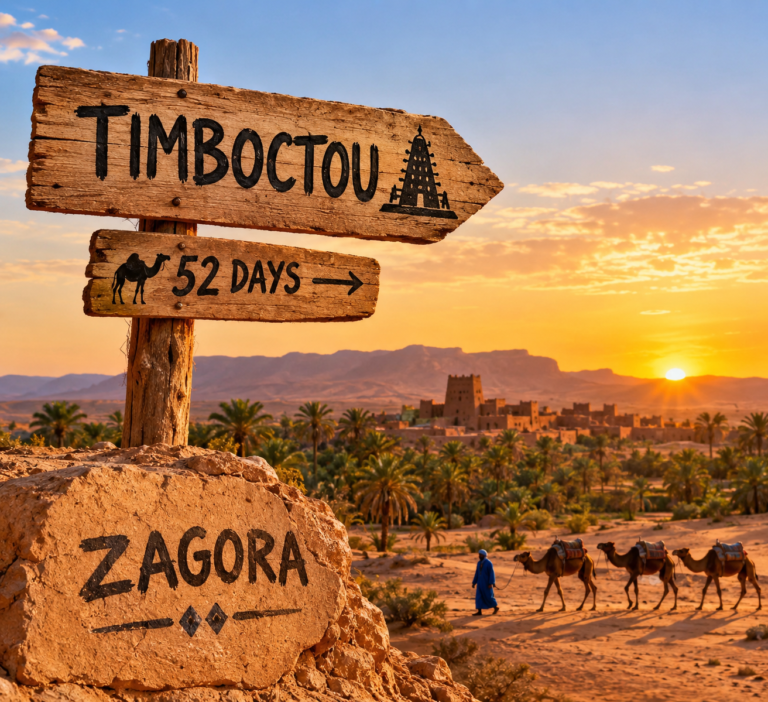
One of the most famous reminders of the area’s historical connection with the Sahara is the traditional sign often associated with the town:
“Timbuktu 52 days.”
The inscription refers to the approximate time that an old caravan could take to travel from here toward Timbuktu in Mali.
The Beautiful Drâa Valley
One of the area’s greatest attractions is not a single monument but the landscape surrounding the town.
The Drâa Valley stretches for hundreds of kilometers and is famous for its enormous palm groves. Date palms grow alongside the river, creating a striking contrast with the dry mountains and desert landscapes.
Walking through the palm groves can feel like entering another world. Small villages, gardens, mud-brick houses, and ancient kasbahs appear between the trees.
The valley is particularly beautiful in the late afternoon, when the sunlight gives the surrounding mountains and palm trees warm golden colors.
Things to Do
1. Explore the Palm Groves
The palm groves are perfect for a relaxing walk or a guided visit. Travelers can see traditional irrigation systems, small agricultural fields, date palms, and villages surrounded by desert scenery.
It is also a wonderful place for photography, particularly in the early morning or late afternoon.
2. Visit Tamegroute
About 20 km from the town, Tamegroute is one of the most interesting places to visit in the Drâa Valley.
The village is famous for its historic Zaouia Naciria, a religious and scholarly center founded in the 17th century. It is also known for its distinctive green pottery, traditionally produced by local artisans.
Visitors can explore the old village, pottery workshops, and historic library when they are open to visitors.
3. Discover the Kasbahs and Ksour
The Drâa Valley contains numerous traditional kasbahs and fortified villages. Their earth-colored walls blend naturally into the surrounding landscape.
Exploring these villages provides a glimpse into the architecture, traditions, and everyday life of southern Morocco.
4. Experience the Desert
The region is closely associated with desert travel, making it a convenient starting point for travelers heading deeper into southern Morocco.
Visitors can arrange camel trekking, 4×4 excursions, desert camps, sunset experiences, and overnight stays under the stars.
The nearby desert has a different character from the enormous golden dunes of Erg Chebbi near Merzouga, but it offers its own peaceful atmosphere and beautiful landscapes.
5. Enjoy a Camel Ride
A camel ride is one of the classic experiences of southern Morocco. Riding through the desert landscape around sunset allows travelers to slow down and enjoy the silence of the Sahara.
For many visitors, spending the night in a desert camp after a camel ride becomes one of the most memorable parts of their Morocco trip.
6. Visit the Local Souk
The local souk provides an opportunity to experience everyday life in the town. Depending on the day, visitors can find fresh produce, dates, spices, clothing, traditional products, and household goods.
A visit to the market is also a good way to experience the area away from the main tourist routes.
Zagora or Merzouga?
Travelers sometimes wonder whether they should visit Zagora or Merzouga. The two destinations offer different experiences.
The former is closer to Marrakech and is particularly interesting for travelers who want to discover the Drâa Valley, palm groves, kasbahs, traditional villages, and desert landscapes of southern Morocco. (Around 370 km from Marrakech.)
Merzouga, on the other hand, is famous for the spectacular Erg Chebbi dunes, with large golden sand dunes and a wide range of desert camp experiences. (Around 550 km from Marrakech.)
If you have enough time, visiting both areas can give you a broader understanding of Morocco’s diverse desert regions.
Best Time to Visit
The best seasons to visit are generally spring and autumn, when daytime temperatures are more comfortable for exploring.
Winter can also be a pleasant time to travel, although desert nights can become cold. Summer is much hotter, especially during the middle of the day, so travelers should plan outdoor activities for the morning or late afternoon and stay well hydrated.
How to Get There
The town can be reached by road from several Moroccan destinations.
A popular route is:
Marrakech → High Atlas Mountains → Ait Benhaddou → Ouarzazate → Agdez → Drâa Valley → Zagora
The journey itself is part of the experience, with dramatic mountain scenery, ancient kasbahs, palm groves, and desert landscapes along the way.
It can also be combined with destinations such as Ouarzazate, Agdez, Nkob, M’Hamid, Erg Chegaga, and Merzouga, depending on the length and route of your Morocco trip.
Zagora and the Sahara Desert
For travelers interested in the Sahara, this region offers an excellent introduction to southern Morocco. It combines desert landscapes with living traditions, agriculture, ancient caravan routes, and communities whose lives remain closely connected to the surrounding environment.
Rather than simply passing through, consider spending some time exploring the Drâa Valley. The combination of palm groves, kasbahs, mountains, and desert scenery makes this part of Morocco especially rewarding.
Exploring Southern Morocco with Sahara Desert Crew
At Sahara Desert Crew, we arrange private and small-group Morocco tours that can include the Drâa Valley and the surrounding desert region.
Depending on your itinerary, the area can be combined with Marrakech, Ouarzazate, Ait Benhaddou, M’Hamid, Erg Chegaga, Merzouga, Dades Valley, and other destinations in southern Morocco.
Our approach is to keep the journey comfortable but authentic, with flexible itineraries that can be adapted to your interests, available time, and preferred travel style.
For travelers who want to discover southern Morocco beyond the usual routes, this desert destination can be a fascinating addition to a Morocco desert itinerary.