
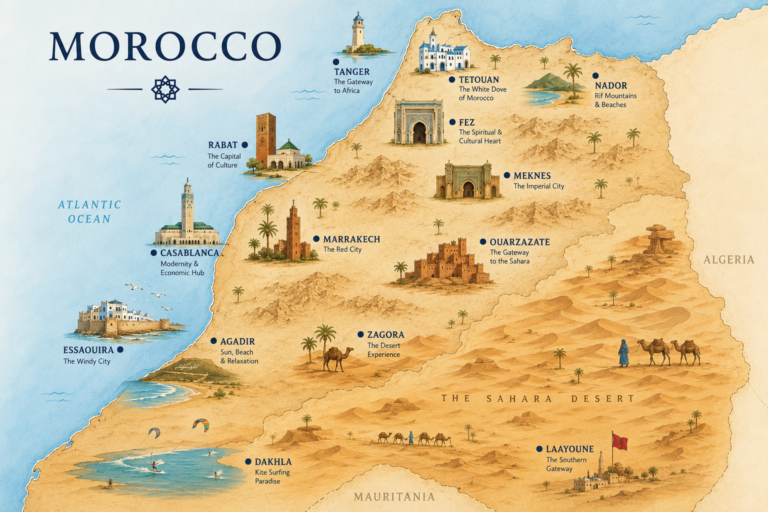
Morocco is a country where history comes alive. From prehistoric human settlements to powerful Berber dynasties, imperial cities, and vibrant traditions, Morocco offers one of the richest cultural heritages in the world. Located at the crossroads of Africa, Europe, and the Middle East, It has been shaped by centuries of migration, trade, and cultural exchange.
Today, visitors can explore ancient medinas, desert kasbahs, mountain villages, and archaeological sites that tell the story of a civilization stretching back hundreds of thousands of years.
The World’s Oldest Homo Sapiens: The Jebel Irhoud Discovery
One of the most important archaeological discoveries of recent decades was made in Morocco.
In 2017, scientists announced that human fossils discovered at Jebel Irhoud, near Safi, were approximately 300,000 years old. This finding pushed back the known origins of Homo sapiens by around 100,000 years and changed our understanding of human evolution.
Jebel Irhoud is now considered one of the oldest known sites associated with modern humans. The fossils included skull fragments, teeth, and stone tools, suggesting that early humans were already living in North Africa long before previously believed.
This remarkable discovery placed the Country at the center of the story of humanity and highlighted the country’s importance in prehistoric research.
The Indigenous People: The Amazigh (Berbers)
Long before the arrival of Arabs, Romans, or Europeans, Morocco was inhabited by the Amazigh people, often known as Berbers.
The Amazigh have lived across North Africa for thousands of years and developed their own languages, traditions, architecture, and social systems. Today, Amazigh culture remains an essential part of Moroccan identity.
Visitors can still experience Amazigh traditions in the:
- Atlas Mountains
- Sahara Desert
- Anti-Atlas region
- Rif Mountains
Traditional music, crafts, carpets, silver jewelry, and village architecture continue to reflect this rich heritage.
The Great Berber Dynasties:
Throughout history, several powerful Amazigh dynasties transformed Moroco into one of the leading political and cultural centers of the Islamic world.
The Almoravid Dynasty (1040–1147)
The Almoravids emerged from the Sahara and established a vast empire that stretched across Morocco, parts of Algeria, and southern Spain.
Their greatest achievement was the founding of the city of Marrakech in 1070, which became their capital and remains one of Morocco’s most famous destinations today.
The Almoravids helped spread Islam, strengthened trade routes across the Sahara, and promoted architectural development.
The Almohad Dynasty (1121–1269)
The Almohads succeeded the Almoravids and created one of the largest empires in North African history.
Their territory extended from Libya to the Atlantic Ocean and included much of Al-Andalus (Muslim Spain).
The Almohads built many iconic monuments that still exist today, including:
- Koutoubia Mosque
- Hassan Tower
- Giralda
Their era is often considered a golden age of learning, philosophy, and architecture.
The Marinid Dynasty (1244–1465)
The Marinids established their capital in Fes and invested heavily in education and religious institutions.
Many of the famous madrasas (Islamic schools) of Fes were built during this period, including:
- Bou Inania Madrasa
- Al Attarine Madrasa
The Marinids helped make Fes one of the most important intellectual centers in the Islamic world.
The Saadian Dynasty (1549–1659)
The Saadians defended Morocco against foreign invasions and strengthened the country’s independence.
Their victory at the Battle of the Three Kings established Morocco as a major regional power.
One of the most beautiful monuments from this period is the Saadian Tombs, famous for its intricate decoration and craftsmanship.
The Alaouite Dynasty (1666–Present)
The Alaouite Dynasty has ruled Morocco for more than three centuries and continues to govern the country today.
Under the Alaouites, Morocco modernized while preserving its cultural identity. Many historic cities, palaces, and monuments were restored, helping protect Morocco’s heritage for future generations.
Imperial Cities
Morocco’s history is reflected in its four Imperial Cities:
Marrakech
Known for its red walls, palaces, gardens, and bustling souks.
Fes
Home to one of the world’s oldest universities and the largest car-free medina.
Meknes
A historic capital known for monumental gates and royal architecture.
Rabat
Morocco’s modern capital and a UNESCO-listed historical city.
Each city reflects a different chapter of Morocco’s long and fascinating story.
Culture, Traditions, and Daily Life
Moroccan culture is a blend of Amazigh, Arab, African, Andalusian, Jewish, and Mediterranean influences.
Visitors are often captivated by:
- Traditional Moroccan cuisine
- Colorful souks and markets
- Handcrafted carpets and pottery
- Gnawa and Amazigh music
- Hospitality and tea ceremonies
- Traditional architecture and riads
These traditions continue to thrive throughout the country, making Morocco a destination where history is not only preserved but lived every day.
Exploring Morocco’s Heritage with Sahara Desert Crew
For travelers interested in discovering Morocco’s rich history and culture, Sahara Desert Crew offers journeys through the country’s most fascinating regions.
Popular cultural experiences include:
- Exploring the ancient medinas of Fes and Marrakech
- Visiting the UNESCO-listed Ait Ben Haddou
- Discovering Amazigh villages in the Atlas Mountains
- Meeting local communities in the Sahara Desert
- Visiting kasbahs, ksour, and historic caravan routes
- Exploring the argan forests near Essaouira and Agadir
You can learn more about Morocco tours on Sahara Desert Crew.