Jemaa el Fna Square Marrakech: The Beating Heart of the Red City
If there is one place that captures the spirit of Marrakech, it is Jemaa el-Fna Square.
Located at the entrance to the old Medina, just beside the famous Koutoubia Mosque, Jemaa el-Fna is much more than a traditional city square. It is a place where history, food, music, storytelling and everyday Moroccan life come together.
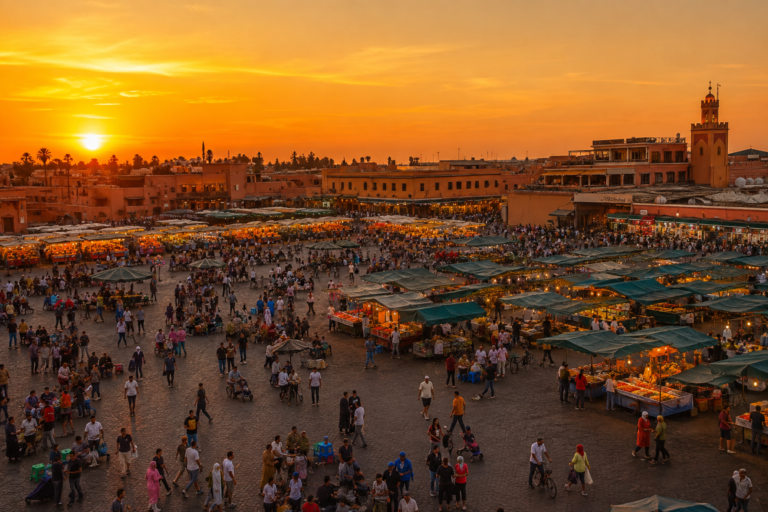
During the day, the square has a relaxed but lively atmosphere. As the sun begins to set, everything changes. Food stalls appear, musicians gather, smoke rises into the evening air and crowds form around performers.
By night, Jemaa el-Fna becomes one of the most fascinating places to experience Marrakech nightlife.
UNESCO describes the square as a unique cultural space and an open-air theatre where traditional Moroccan expressions have been performed for generations. Its cultural space was proclaimed a UNESCO Masterpiece of the Oral and Intangible Heritage of Humanity in 2001 and inscribed on the Representative List in 2008.
A Short History of Jemaa el-Fna
To understand Jemaa el-Fna, it helps to understand the history of Marrakech itself.
Marrakech was founded by the Almoravids around 1070–1072. The city soon became an important political, economic and cultural centre in North Africa and the western Muslim world.
Jemaa el-Fna developed as one of the city’s main public spaces. For centuries, it has been used for commerce, public gatherings, entertainment and social activities.
The exact origin of the name Jemaa el-Fna remains debated. Different historical interpretations have been proposed, and some connect the name with a mosque or with the square’s darker history as a place associated with public executions.
Whatever the original meaning, the square has continually changed while keeping its role as a meeting place.
That is one of the most remarkable things about Jemaa el-Fna: you are not simply visiting a historical monument—you are stepping into a living piece of Marrakech.
From Medieval Meeting Place to UNESCO Heritage
Unlike a palace or a mosque, Jemaa el-Fna does not depend on walls or monuments to preserve its identity.
Its heritage lives through people.
Storytellers, musicians, performers, food vendors, traditional healers, henna artists and other local practitioners have helped shape the atmosphere of the square over generations.
UNESCO recognizes the square for its oral traditions, performing arts, social practices and cultural expressions.
This is also why Jemaa el-Fna is sometimes described as an open-air theatre.
There is no stage.
There are no seats.
And there is no fixed programme.
Instead, performers create circles of spectators known as halqa, while musicians and storytellers bring their own audiences together.
Jemaa el Fna During the Day
During the daytime, Jemaa el-Fna has a completely different personality.
The square is generally quieter than in the evening, although there is always something happening.
You may see:
- Fresh orange juice stalls
- Traditional water sellers
- Henna artists
- Herbalists
- Street performers
- Musicians
- Local vendors
- Small food stalls
- People coming and going from the Medina
One of the classic Marrakech experiences is stopping at an orange juice stall and enjoying a freshly squeezed glass while watching the activity around you.
The square is also an excellent starting point for exploring the Marrakech souks. From Jemaa el-Fna, you can walk into the narrow streets of the Medina and discover shops selling carpets, leather goods, spices, lanterns, pottery, clothing and traditional Moroccan handicrafts.
When Jemaa el-Fna Comes Alive: The Evening
The real transformation begins in the late afternoon.
As the temperature becomes more comfortable and the sun starts to disappear behind the buildings, the square slowly fills with people.
Food stalls are prepared.
Tables and grills appear.
Musicians start performing.
Groups gather around entertainers.
The smell of grilled meat and Moroccan spices begins to fill the air.
And then, almost without noticing, you realize that the quiet daytime square has turned into a huge open-air gathering.
This is the best time to experience Jemaa el-Fna Square Marrakech.


Jemaa el-Fna Nightlife
When people talk about Marrakech nightlife, they often think about rooftop restaurants, modern bars and nightclubs.
But Jemaa el-Fna offers something completely different.
Its nightlife is traditional, noisy, colourful and spontaneous.
There are no tickets and no official showtimes. The entertainment develops naturally around the square.
You can simply walk around and see what catches your attention.
Traditional Music
Music is an important part of the evening atmosphere.
You may hear groups performing traditional Moroccan music, including Gnawa music, as well as other regional musical traditions.
The sound of drums, metal castanets and traditional instruments adds a special rhythm to the square.
Sometimes a musician attracts a small circle of people.
A few minutes later, that circle can become much larger.
Storytellers and the Halqa
One of the most fascinating traditions connected with Jemaa el-Fna is oral storytelling.
A storyteller stands or sits in the middle while people gather around to listen.
This traditional circle is known as a halqa.
Historically, storytellers could entertain audiences for long periods with legends, stories, poetry, humour and moral tales.
Much of this tradition is performed in Moroccan Arabic, so visitors who do not speak Darija may not understand every word.
But you can still appreciate the performance.
The gestures, expressions, reactions of the audience and rhythm of the storyteller make the experience fascinating.
UNESCO considers these oral traditions an important part of the cultural identity of Jemaa el-Fna.
Eating at Jemaa el-Fna
For many visitors, the food is one of the highlights of an evening in the square.
As darkness falls, numerous food stalls begin serving Moroccan dishes and grilled food.
Depending on the season and stalls operating that evening, you may find:
- Grilled meats
- Brochettes
- Moroccan salads
- Harira soup
- Snail soup
- Grilled vegetables
- Fried fish
- Moroccan bread
- Fresh fruit
- Mint tea
The experience is not only about eating.
It is about sitting among the noise and movement of the square while cooks prepare food in front of you.
Smoke rises from the grills, vendors call out to customers and people move between the stalls.
It can feel chaotic at first—but that chaos is part of the charm.
A Small Tip
If you want to eat at a food stall, take a moment to look around before choosing one. Prices and quality can vary between stalls.
If a vendor gives you a menu or tells you a price, make sure you understand the price before ordering.
The Famous Orange Juice Stalls
Jemaa el-Fna is also famous for its fresh orange juice.
Morocco is well known for its citrus production, and freshly squeezed orange juice is a simple pleasure that visitors can enjoy while exploring Marrakech.
For a few minutes, you can stand beside the square, drink a cold glass of juice and watch Marrakech passing in front of you.
Sometimes the simplest experiences become the memories you remember most.
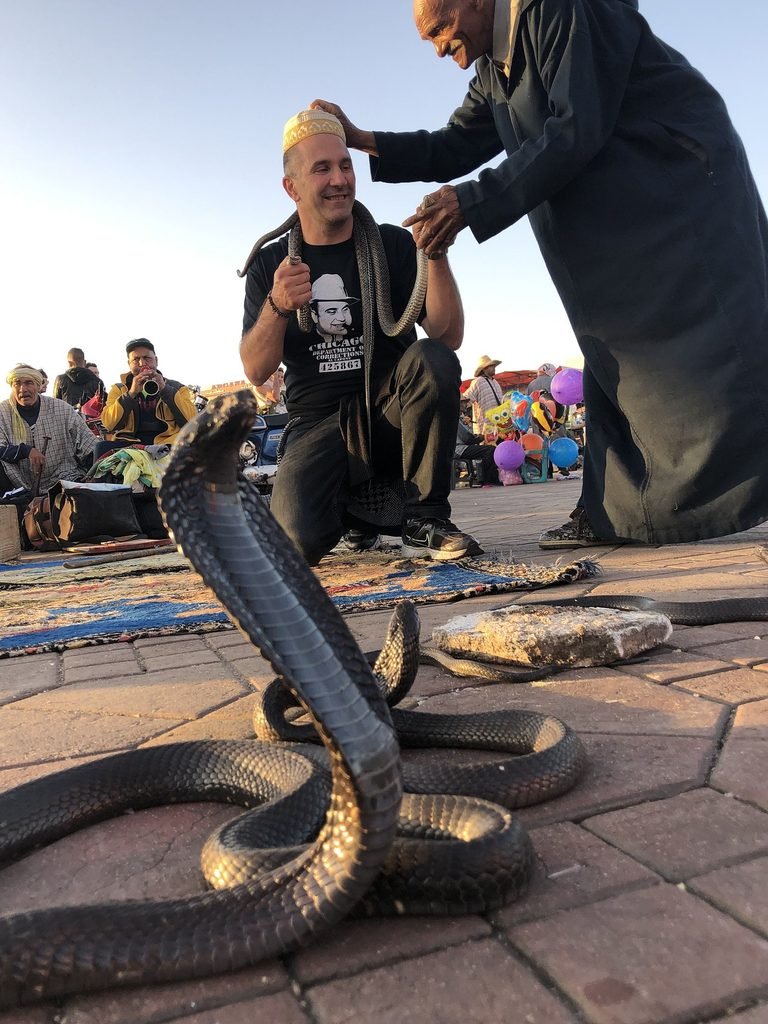
What About the Snake Charmers?
Snake charmers have long been associated with the image of Jemaa el-Fna.
Visitors may still encounter snake-related performances in and around the square.
However, travellers should approach animal performances responsibly and avoid supporting activities that involve poor treatment or exploitation of animals.
The same applies to animal handlers offering photographs.
You can enjoy the atmosphere of Jemaa el-Fna without participating in activities that may raise animal-welfare concerns.
A View From Above
One of the best ways to appreciate Jemaa el-Fna is to find a rooftop café or restaurant overlooking the square.
From above, the scene becomes completely different.
You can see people moving in every direction, food stalls lighting up, smoke rising from the grills and the surrounding Medina slowly becoming illuminated.
Sunset is particularly beautiful.
Grab a Moroccan mint tea, find a table with a view and simply watch the square change from day to night.
You don’t always need to be part of the crowd.
Sometimes watching it from above is the perfect experience.
Jemaa el-Fna and the Koutoubia Mosque
The Koutoubia Mosque is one of Marrakech’s most recognizable landmarks and stands close to Jemaa el-Fna.
Its minaret rises approximately 77 metres above the city and has been an important landmark of Marrakech for centuries.
The combination of the Koutoubia minaret and Jemaa el-Fna creates one of the most recognizable views in Marrakech.
For photographers, the area around the square is especially beautiful around sunset when the warm light falls across the red walls and the minaret.
Is Jemaa el-Fna Worth Visiting at Night?
Absolutely.
If you only visit Marrakech during the daytime, you are missing half of the experience.
The personality of Jemaa el-Fna changes dramatically after sunset.
During the day, you can explore the square, visit the surrounding souks and enjoy the relaxed atmosphere.
At night, you can experience:
- Moroccan street food
- Traditional music
- Storytelling
- Local performers
- Busy food stalls
- Marrakech’s famous atmosphere
- Rooftop views
- The illuminated Koutoubia
- The lively streets of the Medina
The square is particularly enjoyable if you arrive before sunset and stay for the evening.
Tips for Visiting Jemaa el-Fna
A little preparation can make your visit much more enjoyable.
1. Visit Twice
If you have enough time, visit once during the day and again at night.
The atmosphere is completely different.
2. Arrive Before Sunset
Late afternoon is an excellent time to arrive. You can explore the square before watching it transform into its nighttime version.
3. Watch Your Belongings
Like other busy tourist areas around the world, crowded places require normal precautions. Keep your phone, wallet and belongings secure.
4. Ask About Prices
Before buying food, drinks, henna or other services, confirm the price.
5. Respect Local Culture
Remember that Jemaa el-Fna is not simply a tourist attraction. It is also a place where local people meet, work and socialize.
6. Explore Beyond the Square
Don’t leave immediately after visiting Jemaa el-Fna. Walk through the surrounding Medina and souks to experience another side of Marrakech.
The Best Time to Experience Jemaa el-Fna
There is something to see throughout the year, but the atmosphere changes with the seasons.
During the warmer months, evenings are particularly pleasant once the temperature drops.
During winter, daytime can be comfortable while evenings can become surprisingly cool, so carrying a light jacket is a good idea.
For the best experience, plan your visit around sunset and early evening.
That is when the square gradually changes from a daytime market into the famous open-air theatre that travellers come to Marrakech to experience.
Jemaa el-Fna: More Than a Tourist Attraction
What makes Jemaa el-Fna special is not one particular building, restaurant or performance.
It is the combination of everything.
A storyteller gathers a crowd.
A musician begins playing.
A cook prepares dinner.
Someone stops for orange juice.
Families walk through the square.
Travellers photograph the Koutoubia.
Local people meet friends.
Children move through the crowd.
And somewhere in the middle of it all, another story is beginning.
That is the magic of Jemaa el-Fna.
It doesn’t feel like a museum where the past has been frozen behind glass.
The past is still moving here.
UNESCO’s recognition reflects precisely this living cultural character: the square’s heritage is carried by people, performances, oral traditions and everyday social life.
Experience Jemaa el-Fna with a Local Guide
Visiting Jemaa el-Fna on your own is easy, but exploring Marrakech with a local guide can give you a deeper understanding of the city’s history, traditions and hidden corners.
A local guide can help explain the history behind the Medina, introduce you to traditional Moroccan culture and show you places you might otherwise walk past without noticing.
For travellers who want to discover Marrakech beyond the famous tourist sights, a Marrakech walking tour can be a great way to explore the Medina, souks, palaces, mosques and Jemaa el-Fna.
At Sahara Desert Crew, we also combine Marrakech experiences with journeys through the Atlas Mountains, Ait Ben Haddou, the Dades Valley and the Sahara Desert.