
Hassan Tower in Rabat: History, Facts and How to Visit
The unfinished minaret that has watched over Morocco’s capital for more than 800 years.
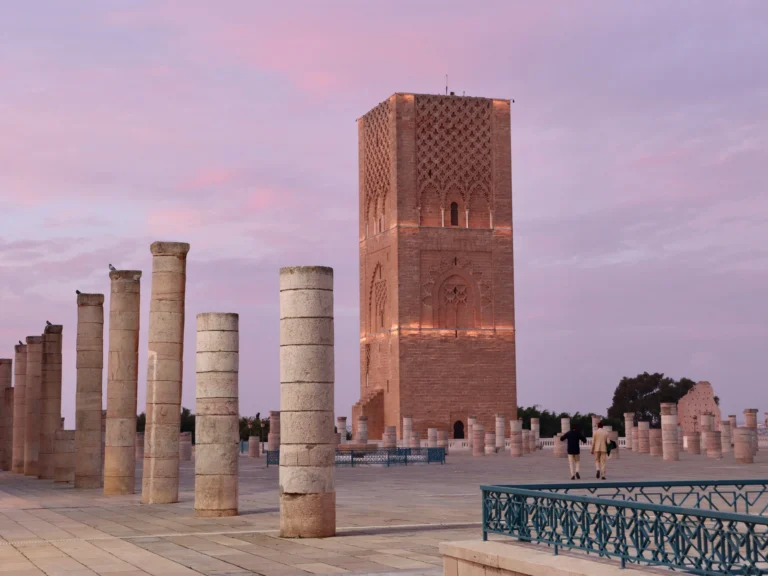
Rising above the Bouregreg River, Hassan Tower (Tour Hassan in French) is one of the most recognizable landmarks in Morocco. Its rose-colored sandstone, its field of broken columns and its unfinished top tell the story of an empire whose ambitions outran its time.
This guide explains the history and design of Hassan Tower, what to see around it, and how to visit, whether on your own or as part of a guided tour.
Quick Facts About Hassan Tower
| Location | Rabat, Morocco |
| Started | 1195, under Almohad caliph Yaqub al-Mansur |
| Current height | About 44 m (planned: about 86 m) |
| Material | Rose sandstone |
| Nearby | Mausoleum of Mohammed V |
| Heritage status | Part of a UNESCO World Heritage site (inscribed 2012) |
| Entry | Free |
The History of Hassan Tower
In 1195, caliph Yaqub al-Mansur ordered a mosque of extraordinary scale for his imperial capital. It was meant to be one of the largest in the Islamic world, with a minaret that would rise higher than any other. The tower was planned as a sibling to the Koutoubia in Marrakech and the Giralda in Seville.
Everything changed in 1199, when al-Mansur died. Work stopped and was never resumed. Time and natural disasters, including the 1755 earthquake that shook the whole region, left the prayer hall in ruins. The tower survived, and its unfinished form is now a symbol of ambition and endurance.
Architecture: What Makes It Special
- Almohad design. Strong geometry, thick walls and carved interlaced arches define the style.
- Four different faces. Each side has its own decorative pattern.
- A ramp, not stairs. Six stacked rooms are connected by a ramp, often explained as a way for a rider on horseback to reach the top.
- The column field. Hundreds of stone and marble column stumps outline the footprint of the vast prayer hall that was never completed.
The Mausoleum of Mohammed V
Across the esplanade stands the white-marble Mausoleum of Mohammed V, completed in 1971. It holds the tombs of King Mohammed V, the father of Moroccan independence, and his sons King Hassan II and Prince Moulay Abdallah.
Highlights include zellige tilework, carved plaster, bronze doors and a green-tiled roof. Visitors, including non-Muslims, can look down into the tomb chamber. Ceremonial royal guards stand at the entrance, and they make for memorable photographs.
Visiting Hassan Tower: Practical Information
- Hours: Open daily during daytime, commonly around 8:30 AM to 6:00 PM. Hours can change on holidays, so confirm locally.
- Entry: Free for the esplanade and the mausoleum.
- Time needed: 45 to 90 minutes.
- Dress code: Modest clothing, with shoulders and knees covered.
- Best light: Early morning or late afternoon, when the sandstone glows.
- Best seasons: Spring and autumn, as the esplanade has little shade.
Visit Hassan Tower on a Guided Tour
Rabat is easy to see on a day trip, but a guide brings the history to life and removes the logistics of transport, parking and timing. If you want Hassan Tower to be part of a bigger Moroccan journey, the team at Sahara Desert Crew arranges tours that include this Rabat highlight.
Combining Rabat with other destinations is a popular way to see Morocco’s imperial cities and landscapes in one trip. You can explore Morocco tours with Sahara Desert Crew to see which itineraries pass through the capital, or contact them to build a private route that suits your dates and interests.
Why book a guided tour?
- Local context on Almohad history and royal heritage
- Door-to-door transport, with no worrying about taxis or trains
- Time to combine Hassan Tower with the Kasbah of the Udayas, Chellah and the medina
- Flexible planning if you are traveling from Fes, Casablanca, Marrakech or elsewhere
What Else to See Near Hassan Tower
- Kasbah of the Udayas: a blue-and-white fortified quarter above the river mouth
- Chellah: Roman and medieval ruins set in gardens
- Rabat Medina and Old Market: local food and shopping
- Mohammed VI Museum of Modern and Contemporary Art
- Royal Palace area: visible from the outside
Frequently Asked Questions
Who built Hassan Tower? Construction began in 1195 under the Almohad caliph Yaqub al-Mansur.
Why is Hassan Tower unfinished? The project stopped when al-Mansur died in 1199.
Is Hassan Tower free to visit? Yes, entry to the esplanade and the Mausoleum of Mohammed V is free.
Can non-Muslims enter the Mausoleum of Mohammed V? Yes, they can enter and view the tomb chamber from above.
Can I visit Hassan Tower on a guided tour? Yes. Sahara Desert Crew arranges tours that cover this highlight of Rabat.
How long should I spend there? Most visitors need 45 minutes to 1.5 hours.
Final Thoughts
Hassan Tower is a monument to a moment when an empire reached for the sky. Standing among its columns, with the Mausoleum of Mohammed V gleaming nearby, you feel centuries of Moroccan history at once. Whether you explore independently or with a guide from Sahara Desert Crew, make it a priority on your Rabat itinerary.