
Erg Chebbi Sand Dunes: History, Formation and the Story of Morocco’s Sahara
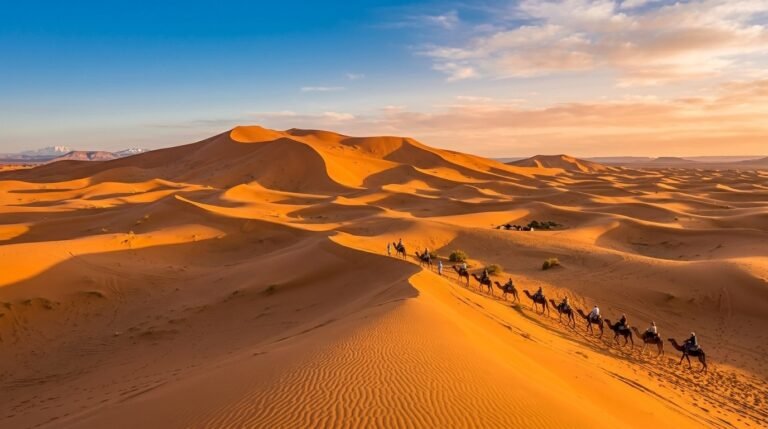
The Erg Chebbi sand dunes are among the most spectacular landscapes in Morocco. Located near the small desert town of Merzouga, in southeastern Morocco, this golden sea of sand attracts travellers from around the world who come to experience the Sahara Desert, ride camels, watch the sunset and spend a night beneath the stars.
But Erg Chebbi is more than a beautiful place for a desert adventure. Behind its impressive dunes is a fascinating story of changing climate, wind, water, ancient landscapes, trade routes and generations of people who have adapted to life in the Sahara.
Where Is Erg Chebbi Sand Dunes?
Erg Chebbi is located in southeastern Morocco, close to Merzouga and not far from the Algerian border. It forms one of Morocco’s best-known sand seas, or ergs.
The word erg is used to describe a large area covered by wind-blown sand dunes. This is important because the Sahara is not made entirely of sand. Much of the Moroccan Sahara consists of rocky plains, gravel and mountains. Erg Chebbi is one of the places where sand has accumulated to create the classic golden desert landscape many visitors imagine when they think of the Sahara.
The dune field is relatively compact, but its dunes are impressive. Some of the highest dunes reach around 150 metres, although this refers to the tallest dunes rather than the average height across the entire erg.
The Ancient History of Erg Chebbi
The history of Erg Chebbi goes much further back than the arrival of tourism or even the development of modern Merzouga.
Thousands of years ago, the Sahara was very different from the dry desert we know today. During the African Humid Period, large parts of North Africa were much wetter, with lakes, rivers, vegetation and wildlife spread across areas that are now extremely dry.
Scientific research at Erg Chebbi has revealed evidence of ancient environmental changes beneath and within the dunes. Researchers studying the famous star dune known as Lala Lallia found very old sand deposits at its base, including material dating back more than 13,000 years. The research also indicates a long gap in dune accumulation before the more recent growth of the large dune seen today.
This tells us something important: the Erg Chebbi landscape has not always looked the way it does today. The desert has continuously changed as climate and wind patterns changed over thousands of years.
How Were the Erg Chebbi Dunes Formed?
The formation of Erg Chebbi is a natural process involving sand, wind, climate and geography.
The region lies within a large basin surrounded by higher rocky landscapes and hamadas. Sediments have also been transported through river systems originating in the Atlas Mountains. Over time, wind has moved and concentrated sand within this landscape, creating the dune field.
The dunes are not simply huge piles of sand that appeared overnight. They are constantly being reshaped by the wind.
One of the most fascinating examples is Lala Lallia, a large star-shaped dune in Erg Chebbi. Research published in Scientific Reports found that the dune is around 150 metres high and 700 metres wide. Scientists found that much of its upper structure accumulated during approximately the last 1,000 years, while the dune continues to migrate slowly westward.
So, although the landscape may appear timeless when you stand on top of a dune, the desert is actually changing all the time.
Erg Chebbi and the Ancient Caravan Routes
Long before international travellers arrived in Merzouga, the wider region was connected to the historic trans-Saharan trade routes.
The Tafilalet region, where Merzouga is located, was an important gateway between northern Morocco and the Sahara. Nearby Rissani grew around the historic settlement of Sijilmassa, which became an important centre for trans-Saharan commerce between North Africa and sub-Saharan Africa.
Caravans travelled across the desert carrying valuable goods between different regions. The Moroccan National Tourist Office notes that caravans departed from the area around Midelt, Errachidia and Merzouga carrying goods toward Timbuktu and returning through the same desert routes.
These journeys were difficult and could take weeks or months. Camels were essential because they could travel long distances through arid environments while carrying food, water and goods.
Today, travellers ride camels across Erg Chebbi as part of a desert experience. In the past, camels were not used for tourism; they were an essential part of trade, transport and survival.
The People and Culture of the Merzouga Desert
The history of Erg Chebbi is also the history of the people who have lived around it.
For generations, Amazigh communities and nomadic groups have adapted their lives to the harsh environment of southeastern Morocco. Water, grazing areas, seasonal movement and knowledge of the desert were essential to survival.
Around Merzouga, traditional villages and palm oases demonstrate how people have adapted agriculture and daily life to an environment where water is precious.
The desert has also influenced local music, food, architecture and traditions. Visitors can experience some of this culture today through local communities, traditional music, desert camps and encounters with people from the region.
The Legend Behind the Erg Chebbi Dunes
Alongside the geological and historical story of Erg Chebbi, there is also a famous local legend about how the dunes came to be.
According to the story, a wealthy community refused to help a poor woman and her son who came seeking food and shelter. As punishment for their lack of hospitality, a huge sandstorm buried the settlement beneath the dunes.
Whether taken as history or legend, the story reflects an important value found throughout desert communities: hospitality.
For centuries, travellers crossing the Sahara depended on the generosity and assistance of others. Water, food and shelter could mean the difference between life and death during a desert journey.
Erg Chebbi Today
Today, Erg Chebbi is one of Morocco’s most popular destinations for experiencing the Sahara Desert.
Travellers come to Merzouga to explore the dunes by camel, 4×4 or on foot. Many visitors arrive in the afternoon and take a camel trek into the dunes before watching the sunset from a high dune.
After sunset, travellers spend the night in a Sahara Desert camp, enjoying traditional Moroccan food, tea and local music before sleeping under a sky filled with stars.
The next morning, one of the most memorable moments is watching the sunrise over the Erg Chebbi dunes. The colour of the sand changes as the sun rises, creating shades of gold, orange and red across the desert.
For adventure lovers, Erg Chebbi also offers activities such as quad biking, sandboarding, 4×4 desert excursions and desert trekking.
Why Visit Erg Chebbi?
What makes Erg Chebbi special is the combination of nature, history and culture.
You are not simply visiting a collection of sand dunes. You are standing in a landscape shaped by thousands of years of environmental change and connected to the history of caravan routes, oasis communities and desert cultures.
The silence of the dunes can also be surprisingly powerful. After travelling through Morocco’s busy cities and mountain roads, reaching the Sahara feels like entering another world.
Whether you are interested in photography, adventure, history or simply want to experience the magic of the Sahara, Erg Chebbi is one of the best places to visit in Morocco.
Experience the History of Erg Chebbi
A visit to Erg Chebbi is best experienced slowly. Walk across the dunes, meet local people, learn about desert life and take time to watch the changing colours of the sand.
At Sahara Desert Crew, we help travellers discover the Merzouga desert through camel trekking, desert camps, 4×4 excursions and private Morocco desert tours. Our journeys can also combine Erg Chebbi with destinations such as Aït Benhaddou, Ouarzazate, Dades Valley, Todgha Gorges and Rissani.
The history of Erg Chebbi reminds us that the Sahara is not an empty place. Its dunes have been shaped by nature, crossed by travellers and surrounded by communities for generations.
Today, when you stand on a golden dune and look across Erg Chebbi, you are looking at a landscape with a story thousands of years in the making.