
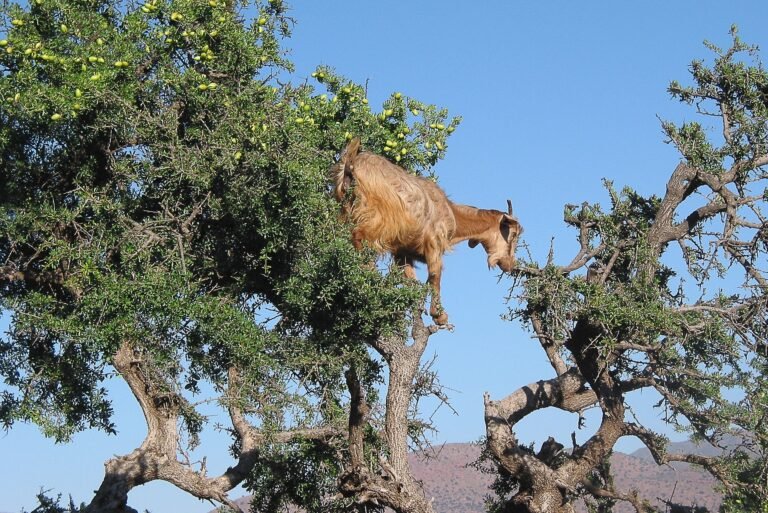
What Is the Argan Tree?
The argan tree (Argania spinosa) is a unique species native to southwestern Morocco. It is famous for its ability to survive harsh drought conditions and for producing the valuable argan nuts used to make argan oil.
The argan tree is so important that the Arganeraie region was designated as a UNESCO Biosphere Reserve in 1998. The reserve covers approximately 2.5 million hectares and protects one of the world’s most unique ecosystems.
Often called the “Tree of Life,” the argan tree has supported local communities for centuries by providing food, oil, animal feed, shade, and protection against desertification.
Where Do Argan Trees Grow?
Argan trees grow naturally almost exclusively in southwestern Morocco.
The largest concentrations can be found between:
- Essaouira
- Agadir
- Taroudant
- Tiznit
- The Souss Valley
The famous Argan Forest stretches across a vast region between the Atlantic coast and the foothills of the High Atlas and Anti-Atlas Mountains. UNESCO recognizes this area as a globally important biosphere reserve.
Travelers driving between Marrakech and Essaouira often encounter beautiful argan landscapes along the road.
Why Are Argan Trees So Special?
The argan tree is exceptionally well adapted to Morocco’s dry climate.
Its deep root system helps stabilize the soil and prevent desertification while allowing the tree to survive long periods without rain. Scientists believe the species has existed in Morocco for millions of years and remains one of North Africa’s most remarkable trees.
Today, argan forests play an essential role in:
- Protecting biodiversity
- Preventing soil erosion
- Supporting rural communities
- Preserving traditional Amazigh culture
- Producing world-famous argan oil
How Is Argan Oil Produced?
Argan oil comes from the kernels found inside the fruit of the argan tree.
The traditional process involves:
1. Harvesting the Fruit
The fruits are collected when fully ripe.
2. Drying
The fruits are dried under the Moroccan sun.
3. Cracking the Nuts
The hard shells are carefully cracked by hand to extract the kernels.
4. Pressing the Kernels
The kernels are pressed to produce the famous argan oil.
This process has traditionally been carried out by local women’s cooperatives, helping support thousands of families throughout the region. UNESCO has also recognized the traditional knowledge associated with argan production as part of Morocco’s intangible cultural heritage.
Culinary Argan Oil vs Cosmetic Argan Oil
Many visitors are surprised to learn that there are two types of argan oil.
Culinary Argan Oil
- Made from roasted kernels
- Rich, nutty flavor
- Used with bread, salads, and traditional Moroccan dishes
Cosmetic Argan Oil
- Made from unroasted kernels
- Used for skin care
- Used for hair treatment
- Popular in beauty products worldwide
Both varieties are highly valued for their natural properties.
The Famous Goats in the Argan Trees
One of Morocco’s most unusual sights is seeing goats climbing argan trees.
The goats are attracted by the fruit and can often be seen balancing on the branches. This unique spectacle is particularly common along the roads between Essaouira and Agadir.
Today, many travelers stop to photograph these remarkable animals during their journey through the argan-growing regions.
Visiting the Argan Forest Near Essaouira
The region surrounding Essaouira offers some of Morocco’s most beautiful argan landscapes.
Visitors can:
- Visit local women’s cooperatives
- Learn how argan oil is produced
- Discover rural Amazigh culture
- See goats climbing argan trees
- Enjoy scenic drives through the countryside
The countryside around Essaouira is particularly attractive because of its proximity to the Atlantic Ocean and its traditional atmosphere.
Visiting the Argan Forest Near Agadir
The area around Agadir contains some of the largest argan forests in Morocco.
Travelers can visit:
- Rural cooperatives
- Traditional farms
- Protected forest areas
- Scenic viewpoints
- Amazigh villages
The region is an excellent destination for travelers interested in nature, culture, and sustainable tourism.
Argan Forest Tours with Sahara Desert Crew
At Sahara Desert Crew, we offer customized Morocco tours that include visits to the beautiful argan forests near Essaouira and Agadir.
These experiences can be included as part of:
- Marrakech to Essaouira day trips
- Agadir excursions
- Southern Morocco tours
- Customized private itineraries
- Multi-day Morocco adventures
Guests have the opportunity to visit authentic cooperatives, learn about traditional argan oil production, meet local communities, and explore some of Morocco’s most scenic rural landscapes.
Whether you are traveling from Marrakech, Agadir, or Essaouira, an argan forest visit provides a fascinating insight into one of Morocco’s most valuable natural treasures.
For more information about private tours and customized itineraries, visit Sahara Desert Crew
Best Time to Visit the Argan Forest
The argan region can be visited throughout the year.
Spring (March to May)
- Pleasant temperatures
- Green landscapes
- Excellent sightseeing conditions
Autumn (September to November)
- Comfortable weather
- Ideal for excursions
Winter
- Mild temperatures along the coast
- Fewer tourists