
Mosques in Morocco: Faith, Craft and Community
Five times a day, from Tangier to Tafraoute, the same call rises over Morocco’s rooftops. It drifts across the red walls of Marrakech, the tiled maze of Fez and the whitewashed lanes of Essaouira, and for a few minutes the rhythm of the street bends around it. Shops pause, neighbours turn toward the nearest mosque, and the day is marked off not by a clock but by prayer.
Morocco has thousands of mosques, and nearly every neighbourhood has one. They are places of worship, but also centres of learning, charity and community, and their minarets are the signature of the Moroccan skyline. This article explores what the mosque means in Moroccan life, the faith that fills it, the craft that built it, and the great landmarks you can see, and how to visit with respect.
Faith in Moroccan life
Islam reached Morocco in the late 7th century, and over the centuries it became the shared frame of the country’s identity. Today Sunni Islam is the established religion in the constitution, and the king holds the title Amir al-Mu’minin, Commander of the Faithful, which combines religious and political authority.
Morocco’s official religious identity is usually described as resting on three traditions, with the monarch’s role as a fourth anchor:
- The Maliki school of jurisprudence, one of the four Sunni schools, known for its emphasis on community consensus and local custom, which suits a country as culturally varied as Morocco.
- Ash’ari theology, a rationalist creed that Moroccan scholars see as a counterweight to literalist readings of scripture.
- Sunni Sufism, the spiritual dimension of the faith, visible in the veneration of local saints, devotional music and the annual festivals called moussems.
These ideas were reinforced in the years after the 2003 Casablanca bombings, when the state reorganised religious institutions and the training of imams to promote what it calls a moderate, Moroccan Islam. Analysts debate how far this blends religion and politics, but the practical result for most people is simple: a shared, familiar way of worshipping that feels local.
For believers, the value of faith is rarely abstract. It is a daily structure of prayer, fasting in Ramadan, charity, family obligations and hospitality, and it gives ordinary life a rhythm and a sense of belonging. The mosque is where that structure becomes visible.
What a mosque is for
The Arabic word masjid means a place of prostration, and the heart of any mosque is the prayer hall, oriented toward Mecca (the qibla). A niche called the mihrab marks that direction, and a pulpit, the minbar, is where the imam delivers the Friday sermon. Before praying, worshippers wash in an ablution area, which is why Moroccan mosques so often have a fountain in the courtyard.
The mosque serves several roles at once:
- Daily prayer. The five prayers (dawn, midday, afternoon, sunset and night) are announced by the muezzin from the minaret.
- Friday gathering. The Friday midday prayer includes a sermon (khutba), and the largest crowds of the week come together.
- Ramadan. During the fasting month, mosques fill each evening for the special night prayers called taraweeh, and families break the fast nearby.
- Learning. Many mosques teach Quran recitation and religious sciences to children and adults.
- Charity and community. Mosques are natural meeting points for giving, support and neighbourhood life.
A few features are distinctly Moroccan: the square minaret rather than the round Ottoman-style one, courtyards with fountains, and, in many historic mosques, roofs covered in green tiles.
Architecture and craft
Moroccan mosque design grew from the Hispano-Moorish tradition shared with Andalusia, and each ruling dynasty added its own accent. The Almohads (12th century) favoured strong, austere forms: bare walls, plain or polylobed arches and tall square minarets. Later dynasties added richer decoration.
The craft vocabulary repeats across the country:
- Zellige, hand-cut glazed tile mosaics in geometric patterns.
- Carved plaster and cedar, used for arches, ceilings and doors, with calligraphy and vegetal motifs.
- Horseshoe arches and columns, which give prayer halls their forest-like rhythm.
- The minaret, always square, often topped by a lantern and metal orbs.
- Green tile roofs, traditionally linked to Islam and to sacred buildings.
Because Islamic tradition avoids figurative images in places of worship, the decoration is abstract: geometry, calligraphy and plant forms. Moroccan artisans, many working in guild traditions handed down for generations, remain the heart of the story. When the Hassan II Mosque was built in the 20th century, it was Moroccan craftsmen from across the kingdom who carved and tiled it.
Landmark mosques
| Mosque | City | Era | Notable for |
|---|---|---|---|
| Hassan II Mosque | Casablanca | Completed 1993 | 210 m minaret, 25,000 worshippers indoors, 80,000 more on the grounds |
| Koutoubia Mosque | Marrakech | Founded 1147; current mosque 1158-1195 | 77 m Almohad minaret, model for Seville’s Giralda and Rabat’s Hassan Tower |
| Al-Qarawiyyin | Fez | Founded 857 or 859 | Often called the oldest continuously operating university in the world |
| Mosque of the Andalusians | Fez | Founded 859 (tradition) | Founded by Fatima al-Fihri’s sister, Mariam |
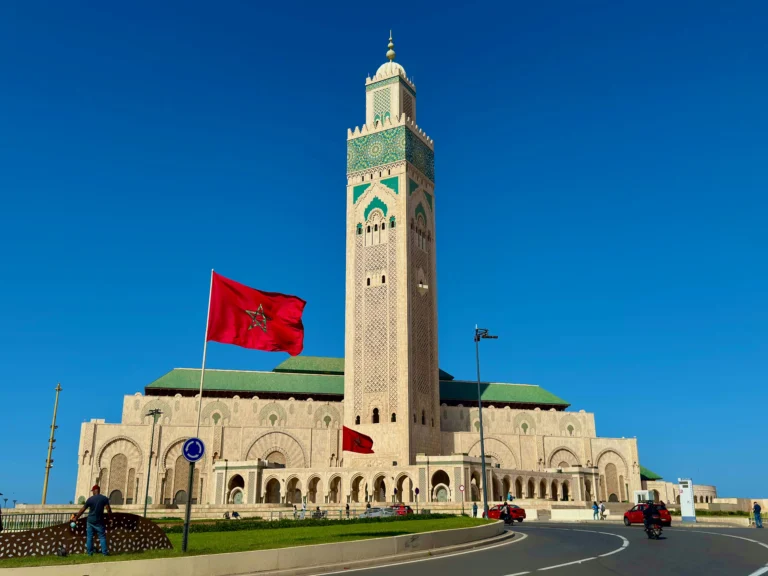
Hassan II Mosque, Casablanca. Built between the 1980s and 1993 on a rock jutting into the Atlantic, it was designed by Michel Pinseau under King Hassan II’s guidance and built by Moroccan artisans. Materials came from across the country: cedar from the Middle Atlas, marble from Agadir and granite from Tafraoute. It is the largest mosque in Morocco and its minaret, at 210 metres, is among the tallest in the world. A retractable roof opens the prayer hall to the sky, a laser at the top points toward Mecca, and the ablution hall has 41 fountains. The complex covers about 9 hectares.
Koutoubia Mosque, Marrakech. Founded in 1147 by the Almohad caliph Abd al-Mu’min after he took Marrakech from the Almoravids, with the present mosque completed between 1158 and 1195. Its name is linked to the booksellers who once worked at its foot, as many as 100 of them. The 77-metre minaret, including its 8-metre spire, follows the Almohad proportion of height to width and is the city’s most recognisable landmark. Local rules keep new buildings from rising above it.
Al-Qarawiyyin, Fez. Founded in 857 or 859 by Fatima al-Fihri, a wealthy merchant’s daughter whose family had migrated from Kairouan in Tunisia, it grew over a thousand years into a major centre of Islamic learning and became a state university in 1963. Historians note that the claim of a university from the start is more legend than documented fact, but its role as an intellectual hub is secure. Its library was restored and reopened in 2016.
Others worth knowing. The Hassan Tower in Rabat is the unfinished minaret of a huge 12th-century mosque begun by the Almohads. Tinmel, in the High Atlas, is the restored Almohad mosque where the dynasty’s movement took shape. In Fez, the Bou Inania Madrasa is a masterpiece of carved cedar and zellige. These are described here from general knowledge, so check access and opening times before you go.
If you are looking for a Morocco tour that combines visits to beautiful mosques, historical landmarks, and the country’s most fascinating sights, Sahara Desert Crew can help you plan a trip that matches your interests. From exploring the impressive Hassan II Mosque in Casablanca and the historic medinas of Fes and Marrakech to discovering ancient kasbahs, the Atlas Mountains, and the Sahara Desert, we can customize your itinerary to include the places you wish to visit. Contact Sahara Desert Crew to create a private Morocco journey at your own pace.