
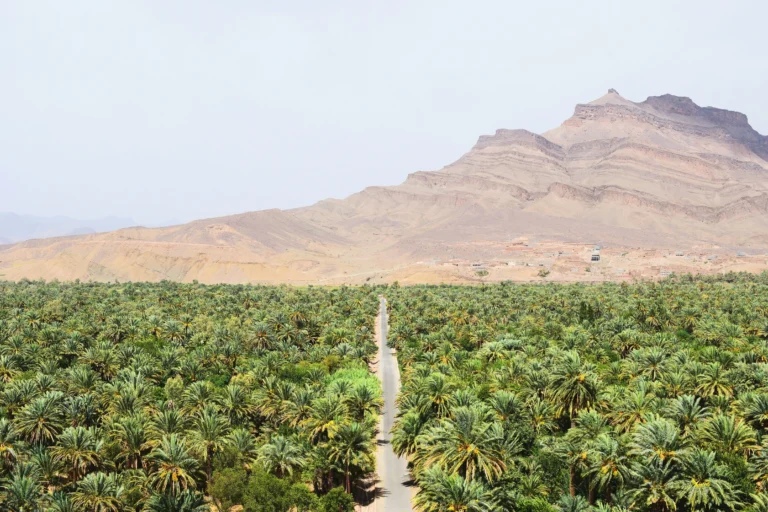
The Draa Valley: Morocco’s Ribbon of Green
Drive south from the High Atlas and, somewhere past Agdz, the landscape changes its mind. Red rock and scrub give way to a ribbon of date palms, barley fields and mud-brick villages, all hugging a river that most of the year barely seems to flow. This is the Draa Valley, Morocco’s great oasis corridor, and it runs for roughly 200 kilometres of palm groves before the Sahara takes over at M’Hamid.
It is a place where water, not distance, is the measure of everything. Where the Draa reaches, there are gardens, kasbahs and weekly markets. Where it does not, there are dunes. For travellers heading from Marrakech toward the desert, the valley is the green chapter between the mountains and the sand, and it is worth slowing down for.
The Draa River: Morocco’s longest, and its most stubborn
The Draa (Oued Draa in Arabic, also spelled Dra or Drâa) is Morocco’s longest river, at about 1,100 kilometres. It rises from tributaries in the High Atlas and winds south and east through a series of oases. Its flow is intermittent: seasonal rain and heavy withdrawal for farming mean the riverbed can look dry for long stretches, then surge after mountain storms.
The people of the valley learned to work with that uncertainty. Seguias, small canals, carry water from the river to the fields. The valley was also known for the qatarra, a sophisticated system of underground irrigation channels shared with other ancient desert oases such as Siwa and Ouargla. It is a quiet piece of engineering that explains why a strip of the Sahara can grow dates, pomegranates, barley, wheat and vegetables.
The Upper Draa valley, about 200 kilometres long, is described as six stretches of oases and palm groves running north to south. The first, the Mezguita oasis, includes Agdz and sits just above the Tamsikht dam.
Oases and palm groves: Morocco’s date basket
The valley is best known for its palmeraies, and its reputation as the date basket of Morocco is earned. Dates here are especially sweet, and the so-called Royal Dates are considered the best, and the priciest. Beneath the palms, farmers grow crops in layers: fruit trees, then cereals and vegetables in the shade below.
Three names anchor most journeys:
- Agdz, the northern gateway, known for its date market and a lush palm grove.
- Zagora, the valley’s main town, with a panorama from Jbel Zagora over the palms, the rock desert and the silhouette of Jbel Sarhro.
- M’Hamid El Ghizlane, where the Great Oasis Valleys of Morocco end and the way to Erg Chigaga begins.
Markets punctuate the week. Tinzouline, for example, is known for a Monday souk, and a morning spent wandering one tells you more about valley life than any monument.
Kasbahs and ksars: architecture made of the river
The valley is especially famous for its kasbahs, fortified houses and compounds, and for its ksars, fortified villages. They were built from mud and straw gathered on the riverbanks, a material that stays cool in heat and holds warmth in the cold. Many are still inhabited today.
Near Agdz, two stand out: the Kasbah of Tamnougalt (the kasbah of Caïd Ali) and the Kasbah of Aït Hammou Ousaid. Others, such as Kasbah Oulad Othmane, are often named by visitors as architectural highlights. Mud-brick walls, corner towers and geometric decoration are the signature, and the colour shifts from ochre to deep red as the light moves.
A practical note: earthen buildings need constant care. A kasbah that looks timeless is usually being quietly maintained by the families who live in it, which is one reason to visit with a guide who knows who to ask.
A road older than Morocco
The river is old news to geographers. The Draa appears on the first world map, drawn by Ptolemy (90-168 AD), and was known to the Romans. In 1053-54, the Almoravids began their advance on central Morocco, and their very first campaign was in the Draa valley. The Saadi dynasty later came out of this region, and in the 17th century the Alaouites established their authority here.
For centuries the valley was the start of a caravan highway linking Morocco to Timbuktu, Gao and the kingdoms of the Sahel. Caravans used the oases as overnight stops, and the kasbahs and market towns grew up to serve them. Legend even holds that some of the date palms sprang from stones dropped along the trail.
That trading past is why the valley feels like a crossroads: Arabic, Berber and Saharan influences are layered together in the food, the music and the walls.
People, crafts and ancient carvings
Two languages are heard in the valley: a local variety of Arabic closely related to Hassaniya, and Tashelhiyt, a Berber language. Communities include the Haratin, whose roots are traced to the Sahel, and Berber families who have farmed the same plots for generations.
Tamegroute, near Zagora, is the cultural stop most visitors remember. It is known for its potters’ village and for the region’s oldest library and Quranic school. Rock engravings and cave art across the valley show that people have lived and travelled here for thousands of years.
Bring a little time and curiosity: tea with a local family, a bread-baking lesson or a walk through a village palm grove often becomes the highlight of the trip.
Where the green ends: M’Hamid and the dunes
M’Hamid is the last village before the open desert, and the doorway to Erg Chigaga, one of the largest and wildest dune fields in Morocco. From here, a 4×4 or camel caravan takes you roughly 60 kilometres off-road into the sand, and the contrast is the point: palms and running water behind you, silence and star-filled skies ahead.
Closer to Zagora, the dunes of Tinfou offer a shorter taste of the Sahara. Many travellers combine the valley with Erg Chigaga on a three- or four-day loop from Marrakech, crossing the Tizi n’Tichka pass and Aït Benhaddou on the way south, then returning through the valley by a different road.
Exploring the valley with Sahara Desert Crew
Sahara Desert Crew is a family-run Moroccan tour company founded by Youssef Yaakoubi, who comes from a family of desert nomads, with more than 25 years of local tourism experience. It runs private and small-group tours, tailor-made trips, camel treks, 4×4 and quad adventures, and desert camps, working from Marrakech and Fes across the Atlas, the imperial cities and the Sahara.
The company private tours travel along much of the Draa Valley, combining the oases and kasbahs with desert adventures beyond; the own write-up is Discovering Morocco’s Magical Draa Valley. Because itineraries are flexible, a route that threads Aït Benhaddou, Agdz, Zagora and M’Hamid can be built around the time you have.