
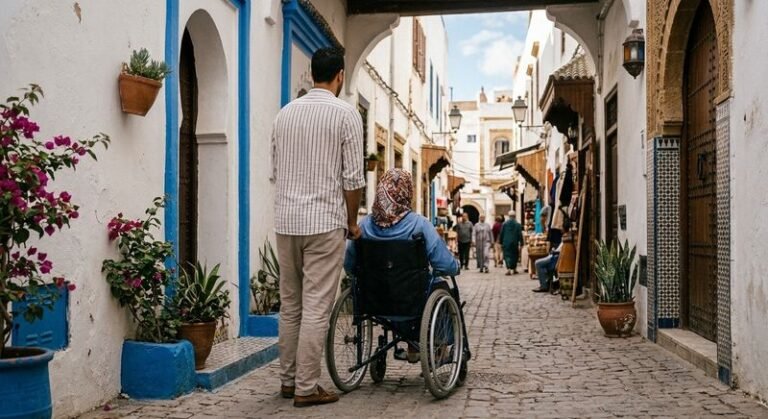
Travelling in Morocco with Disabilities: An Accessible Travel Guide
Planning a trip to Morocco with a disability? Discover practical tips for accessible travel in Morocco, wheelchair-friendly accommodation, private tours, transportation, and how to explore the Sahara Desert more comfortably.
Morocco is a fascinating destination known for its colourful medinas, historic cities, beautiful mountains, traditional villages, and vast Sahara Desert. From the lively streets of Marrakech to the golden dunes of Merzouga, there is plenty to discover. However, travelling in Morocco with a disability requires some preparation, particularly when it comes to transportation, accommodation, walking surfaces, and accessibility at tourist attractions.
The good news is that with careful planning and the right local support, many travellers with disabilities or reduced mobility can enjoy a memorable Moroccan holiday. Whether you use a wheelchair, have difficulty walking long distances, or need additional assistance during your journey, choosing suitable destinations and arranging the right services in advance can make a real difference.
In this guide, we share practical advice to help you plan a more comfortable and enjoyable trip to Morocco.
Is Morocco Accessible for Travellers with Disabilities?
Accessibility in Morocco varies considerably depending on the destination, accommodation, and type of activity. Some modern hotels, restaurants, airports, and tourist facilities offer accessible features, while older buildings and traditional neighbourhoods may present challenges.
Historic medinas often have narrow streets, uneven paving, steps, and crowded walkways. Outside the cities, some rural areas and desert camps have sandy paths, limited paved access, and facilities that may not be suitable for every traveller.
This does not mean that travelling to Morocco with a disability is impossible. It simply means that choosing the right itinerary is important.
Before booking, ask specific questions about wheelchair access, bathroom facilities, vehicle entry, walking distances, and the availability of assistance. Whenever possible, request recent photographs and written confirmation of accessibility features rather than relying only on general descriptions.
Best Places to Visit in Morocco with a Disability
Morocco offers a wide variety of destinations, but some may be easier to explore than others, depending on your individual needs.
1. Marrakech
Marrakech is one of Morocco’s most popular destinations, with traditional markets, gardens, museums, restaurants, and beautiful hotels.
Some modern hotels and larger tourist attractions have accessible facilities. However, the historic Medina can be challenging for wheelchair users because of uneven surfaces, narrow passages, steps, and busy crowds.
Travellers with limited mobility may find it more comfortable to stay in a hotel with confirmed step-free access and arrange private transportation between attractions. A carefully planned visit can include selected gardens, accessible areas of museums, and restaurants with suitable facilities.
Always check the accessibility of individual attractions before visiting.
2. Fes
Fes is famous for its historic medina, traditional crafts, and remarkable architecture. It is also one of the most challenging Moroccan cities for visitors with reduced mobility.
Many streets inside the old Medina are narrow, uneven, steep in places, and inaccessible to vehicles. Some attractions require walking over difficult surfaces or navigating steps.
A private guide can help you select suitable viewpoints, accessible meeting points, and attractions that match your mobility requirements. Travellers who use wheelchairs may prefer to combine a shorter visit to the old city with sightseeing in more accessible areas outside the Medina.
3. Casablanca
Casablanca is a modern city with large hotels, shopping centres, restaurants, and some contemporary public spaces. Certain facilities may offer better accessibility than older historic neighbourhoods.
The Hassan II Mosque is one of the city’s most famous landmarks. Visitors who require step-free access or other assistance should contact the mosque in advance to confirm the arrangements available for their visit.
Private transportation can also make it easier to travel between selected attractions without needing to walk long distances.
4. The Atlas Mountains
The Atlas Mountains offer spectacular landscapes, traditional villages, and opportunities to experience rural Moroccan life.
However, mountain roads, village paths, and traditional accommodation can have steep slopes, uneven ground, and steps. Many walking excursions are not suitable for every mobility level.
Travellers with disabilities can consider scenic drives, selected viewpoints, and visits to locations where vehicle access is possible. Discuss the route with your tour operator beforehand to establish what can realistically be included.
5. The Sahara Desert and Merzouga
For many visitors, a trip to the Sahara Desert is the highlight of a Moroccan holiday. The dunes near Merzouga, traditional music, desert landscapes, and star-filled skies offer a memorable experience.
However, the desert requires additional planning for travellers with disabilities. Deep sand can make wheelchair movement difficult, and standard vehicles may not accommodate every mobility aid. Traditional desert camps may also have sandy pathways, raised entrances, or bathrooms that are not wheelchair accessible.
Travellers can still explore suitable desert experiences by discussing their requirements with a local operator before booking. Depending on individual needs and the facilities available, options may include a scenic drive around the dunes, a sunset viewpoint reachable by vehicle, a night at suitable accommodation, or a specially arranged visit to the desert.
A camel ride or quad excursion is not suitable for everyone and should never be assumed to be accessible. The safest approach is to discuss the available alternatives and choose activities based on personal comfort and mobility.
How to Plan an Accessible Trip to Morocco
Good planning is one of the most important parts of travelling in Morocco with a disability. These steps can help you avoid unnecessary difficulties.
1. Choose Accommodation Carefully
Do not assume that a hotel is wheelchair accessible simply because it has an elevator or describes itself as accessible.
Before confirming a reservation, ask about:
- Step-free access from the entrance to your room.
- Door widths and space to manoeuvre a wheelchair.
- Bathroom layout, including roll-in showers and grab rails.
- Elevator dimensions and access to common areas.
- The distance between the room, restaurant, reception, and parking area.
If you are planning to stay in a riad, ask whether the room is on the ground floor. Traditional riads can have stairs, narrow entrances, and interior layouts that make access difficult.
2. Arrange Suitable Transportation
Transportation is an important consideration for accessible travel in Morocco, especially when travelling between cities.
Standard tourist vehicles may not have wheelchair ramps, lifts, or enough space for a wheelchair or other mobility equipment. If you require an accessible vehicle, confirm its availability before booking and explain whether you need to remain seated in your wheelchair during the journey.
If you can transfer into a vehicle seat, ask whether the wheelchair can be safely stored in the luggage compartment and whether sufficient space is available for your other luggage.
For longer journeys, a private vehicle with a dedicated driver can provide greater flexibility for breaks, rest stops, and changes to the itinerary. However, the vehicle must be suitable for your specific needs.
3. Consider a Private Tour
A private tour can be a practical option for travellers with disabilities because the itinerary can often be adjusted to suit individual requirements.
Instead of following a fixed schedule, you may be able to spend more time at selected attractions, reduce walking distances, take regular breaks, and avoid activities that are difficult or uncomfortable.
When booking, explain your mobility requirements clearly. A reliable operator should be willing to discuss the limitations of the route, accommodation, and activities before accepting the reservation.
Private tours are not automatically accessible, so always confirm the specific arrangements rather than relying on the word “private” alone.
4. Check Accessibility Before Visiting Attractions
Accessibility can differ even between attractions in the same city. Some locations have ramps or level entrances, while others require visitors to climb steps or walk across uneven ground.
Contact attractions in advance to ask about entrances, accessible toilets, parking, seating, and assistance. If you use a wheelchair, find out whether the entire visitor route is accessible or only certain areas.
A realistic itinerary with fewer stops may be more enjoyable than a packed schedule that involves too much walking.
5. Prepare for Morocco’s Climate
Morocco can experience high temperatures, particularly in summer and in desert regions. Travellers who have difficulty walking or who are sensitive to heat may find sightseeing more comfortable during the cooler morning and late afternoon hours.
Carry drinking water, sun protection, necessary medication, and any mobility equipment you rely on. Plan regular breaks and avoid strenuous activities during the hottest part of the day.
If you need refrigerated medication or other specific medical facilities, confirm the arrangements with your accommodation and travel provider before departure.
Can You Visit the Sahara Desert in a Wheelchair?
Yes, a visit may be possible, but the experience depends on your mobility requirements, the equipment you use, and the facilities available.
It is important to understand that the Sahara is not a uniformly accessible destination. Soft sand can prevent standard wheelchairs from moving easily, and not every desert camp has step-free access or an adapted bathroom.
Before booking a Sahara Desert tour, ask your operator the following questions:
- Can the vehicle accommodate my wheelchair or mobility equipment?
- Is the camp accessible from the vehicle drop-off point?
- Are the tent entrance, sleeping area, and bathroom suitable for my needs?
- Is assistance available when getting in and out of the vehicle?
- Can the itinerary include activities that do not require walking across sand?
- What alternatives are available if a planned activity is not suitable?
For travellers with limited mobility, a desert experience based on scenic drives, accessible accommodation where available, and carefully selected viewpoints may be more suitable than a traditional camel trek.
The key is to arrange the experience around the traveller rather than expecting the traveller to adapt to a standard itinerary.
Travelling in Morocco with an Elderly Person or Someone with Reduced Mobility
You do not need to use a wheelchair to benefit from accessible travel planning. Older travellers and people who have difficulty walking long distances may also need additional assistance.
If you are travelling with a parent, grandparent, or family member with reduced mobility, consider choosing hotels with elevators or ground-floor rooms, arranging private transportation, and limiting the number of daily activities.
Allow enough time for meals, rest, and bathroom breaks. Avoid itineraries that involve changing hotels every night if frequent packing and long drives would be tiring.
For a family holiday, a private tour can make it easier to balance sightseeing with everyone’s needs. The itinerary should be discussed with the operator in advance, particularly when travelling with someone who uses a wheelchair or needs help transferring between a vehicle and a chair.
What Is the Best Time to Visit Morocco with a Disability?
Spring and autumn are often comfortable seasons for exploring Morocco because daytime temperatures are generally milder than during the hottest summer months.
March to May and September to November can be good periods to consider for city visits and desert tours. However, weather conditions vary by region, and the Sahara can still be hot during the day or cold at night.
For travellers with reduced mobility, the best time to visit also depends on personal comfort, medical needs, and the type of activities planned. A slower itinerary with suitable accommodation and transportation may be more important than the season itself.
Why Choose Sahara Desert Crew Tours & Adventures?
At Sahara Desert Crew Tours & Adventures, we believe that travelling in Morocco should be about discovering the country in a way that suits each traveller.
As a local tour company specialising in Morocco trips and Sahara Desert experiences, we can discuss private itineraries, transportation arrangements, accommodation options, and activities before your journey begins.
If you are travelling with a wheelchair user, an elderly family member, or someone with reduced mobility, we encourage you to contact us before booking. Tell us about your specific requirements so we can discuss what may be possible, identify potential challenges, and help you plan a realistic itinerary.
Our Morocco tours can include destinations such as Marrakech, Fes, the Atlas Mountains, Ouarzazate, the Dades Valley, and Merzouga. The suitability of each stop depends on the route, facilities, and individual accessibility requirements.
We do not assume that every hotel, vehicle, desert camp, or activity is accessible. Instead, we encourage travellers to confirm the details in advance so expectations are clear.
Planning a trip to Morocco with a disability? Visit Sahara Desert Crew Tours & Adventures to explore our Morocco tours or contact us to discuss a private itinerary that takes your needs into account.
Frequently Asked Questions About Accessible Travel in Morocco
Is Morocco wheelchair-friendly?
Accessibility varies by destination. Some hotels, modern facilities, and selected attractions offer wheelchair access, while historic medinas, rural areas, and sandy desert environments can be difficult to navigate. Researching individual locations and arranging suitable transportation in advance is essential.
Can wheelchair users visit Marrakech?
Yes, a visit may be possible with careful planning. Some attractions and modern facilities may be suitable, but many streets in the old Medina are uneven, narrow, and crowded. Confirm the accessibility of each planned stop before travelling.
Are there wheelchair-accessible desert camps in Merzouga?
Some camps may offer features that assist travellers with reduced mobility, but accessibility standards and facilities vary. Confirm step-free access, bathroom arrangements, the distance across sand, and vehicle access directly with the camp before booking.
Can I book a private Morocco tour if I have limited mobility?
A private tour may offer more flexibility with driving times, sightseeing stops, and rest breaks. However, vehicle accessibility and the suitability of accommodation and activities must be confirmed individually.
What should I tell a tour operator before booking?
Explain whether you use a wheelchair, whether you can transfer into a vehicle seat, whether you can walk short distances, what bathroom facilities you need, and whether you require assistance. Also mention any mobility equipment you will bring.
Is travelling in Morocco with a disability expensive?
Costs depend on your itinerary, accommodation, transportation, and support requirements. A suitable vehicle or specially arranged accommodation may increase the price, so request a detailed quotation based on your individual needs.
Final Thoughts
Travelling in Morocco with disabilities is possible for many people, but it requires realistic expectations and careful preparation. From the historic streets of Fes to the desert landscapes of Merzouga, each destination presents different opportunities and accessibility challenges.
By choosing suitable accommodation, confirming transportation arrangements, allowing time to rest, and working with a tour operator who understands your needs, you can plan a more comfortable and rewarding Moroccan adventure.
The most important step is to communicate your requirements before booking. With the right preparation, you can focus less on unexpected difficulties and more on discovering Morocco’s landscapes, culture, hospitality, and unforgettable experiences.