
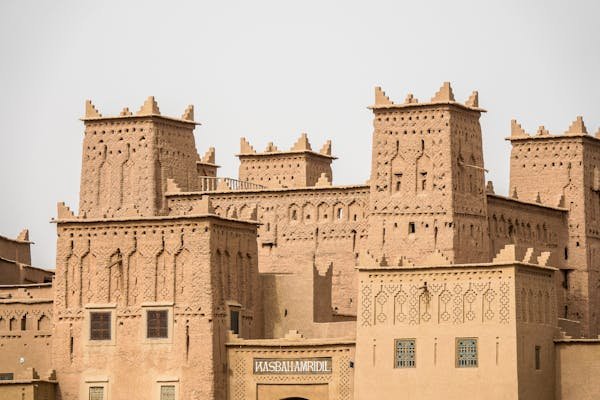
Kasbah Amridil: A Journey into Morocco’s Living Heritage
Hidden among the thousands of palm trees of the Skoura Oasis, in southern Morocco, stands one of the country’s most beautiful examples of traditional earthen architecture: Kasbah Amridil.
With its tall fortified towers, geometric decorations, ancient courtyards and walls built from earth and adobe, Amridil looks almost like a desert castle rising from the palm grove. But beyond its impressive appearance, the kasbah tells a much deeper story — a story of family, craftsmanship, oasis life and the historic routes that once connected Morocco’s cities with the Sahara.
Located about 40 kilometres east of Ouarzazate, Kasbah Amridil is an exceptional stop for travellers exploring southern Morocco and the road toward the Dades Valley and the Sahara Desert.
A Kasbah Surrounded by Palms
The setting is part of what makes Amridil so special.
The Skoura Oasis is famous for its dense palm groves and concentration of traditional kasbahs. Here, the green of the date palms contrasts beautifully with the ochre colours of the surrounding earth and mountains.
Walking toward Amridil through the palm grove, the kasbah gradually appears between the trees. Its tall towers and richly decorated walls create a remarkable scene that represents the architecture of Morocco’s pre-Saharan regions.
The Moroccan National Tourist Office highlights the importance of ksour and kasbahs in southern Morocco, where fortified earthen settlements were traditionally built close to oases.
The History of Kasbah Amridil
The history of Amridil goes back several centuries.
The original settlement on the site dates to the 17th century and was initially a fortified village, or ksar. The present kasbah developed later, with the main fortified residence associated with the Nasiri family.
According to historical accounts, M’hamed Ben Brahim Nasiri, a religious scholar from the area, was connected with the education of the sons of Madani El Glaoui. The Glaoui family subsequently commissioned craftsmen to construct the impressive fortified residence associated with Amridil.
The Nasiri family has remained connected to the kasbah for generations, making Amridil more than simply an archaeological monument. Parts of the complex have continued to have a living family connection.
A Masterpiece of Earthen Architecture
One of the first things visitors notice about Kasbah Amridil is its impressive architecture.
The building is constructed mainly using traditional materials such as rammed earth (pisé), adobe and wood. Its massive walls helped protect the inhabitants from both the harsh desert climate and potential threats.
The main structure has a square plan organized around an interior courtyard and rises several levels high. Four imposing corner towers give the kasbah its distinctive appearance. A fifth tower was added later to the southern side.
The exterior walls are decorated with geometric motifs created from the earth itself. These patterns are not simply decorative; they are part of a long architectural tradition found throughout the oasis regions of southern Morocco.
Inside, the different spaces traditionally had different functions. Storage areas, kitchens, living quarters and terraces were organized according to the needs of family life in the oasis.
The Traditional Life Inside the Kasbah
A visit to Amridil is also an opportunity to understand how people lived in southern Morocco before modern construction transformed the region.
The kasbah was designed around the realities of oasis life.
Thick earthen walls helped regulate temperatures, keeping the interior cooler during the hot summer days and warmer during colder nights. Storage areas were used for agricultural products, while the upper levels provided living spaces for the family.
Traditional tools and objects associated with everyday life can also be found within the restored sections of the complex, giving visitors a glimpse into the agricultural and domestic traditions of the Skoura oasis.
Why Is Amridil So Famous?
Kasbah Amridil has become one of the most recognizable kasbahs in Morocco.
Part of its fame comes from its architecture and beautiful location, but its image has also become closely associated with Morocco’s visual identity. The kasbah was famously featured on the Moroccan 50-dirham banknote issued in 1987, helping introduce its distinctive silhouette to people across the country.
The kasbah has also appeared in cinema, including the 1962 film Lawrence of Arabia, adding another chapter to its international reputation.
A Protected Moroccan Heritage Site
Kasbah Amridil is not simply a popular tourist attraction. It is officially recognized as part of Morocco’s national heritage.
The Moroccan Ministry of Culture lists Kasbah Amridil among the protected heritage sites of the Ouarzazate area, with legal protection established through measures issued in 2017 and 2018.
Its preservation is particularly important because traditional kasbah architecture faces many challenges, including the effects of weather, erosion and the gradual disappearance of traditional building techniques.
Preserving Amridil means preserving not only a building, but also knowledge about how communities adapted to life in the oasis environment.
Visiting Kasbah Amridil
Kasbah Amridil is located in Skoura, making it an excellent stop when travelling between Ouarzazate and the Dades Valley.
A visit can easily be combined with other highlights of southern Morocco, including:
- The Skoura palm grove
- The Valley of Roses
- Dades Gorges
- Todra Gorges
- Ouarzazate and the Kasbah of Taourirt
- Ait Ben Haddou
- The road toward the Sahara Desert
For travellers driving from Marrakech toward Merzouga, Amridil can be an especially interesting stop because it provides a cultural and historical experience between the High Atlas Mountains and the desert landscapes further east.
The Best Way to Experience Amridil
Rather than simply stopping for a quick photograph, take some time to walk through the surrounding palm grove and appreciate the relationship between the kasbah and its environment.
Look closely at the geometric decorations on the walls, the traditional construction techniques and the way the building rises above the palm trees.
A local guide can also make the visit much more meaningful by explaining the history of the Nasiri family, the architecture of the kasbah and the traditional way of life in the Skoura oasis.
For photographers, the combination of earthen architecture, palm trees, mountains and changing desert light makes Skoura one of the most rewarding places in southern Morocco.
Kasbah Amridil: A Story Written in Earth
Kasbah Amridil is much more than an impressive old building.
It is a reminder of a time when architecture was deeply connected to the environment. Earth, wood and water were used intelligently to create homes capable of surviving in one of Morocco’s harshest climates.
It is also a living connection to the history of the Skoura Oasis, where agriculture, family traditions and the ancient routes toward the Sahara shaped local life for generations.
Standing among the palm trees and looking at the towers of Amridil, it is easy to understand why this kasbah has become one of the symbols of southern Morocco.
If your journey takes you from Marrakech or Ouarzazate toward the Dades Valley and the Sahara Desert, Kasbah Amridil is a stop worth making.
Discover Southern Morocco with Sahara Desert Crew
At Sahara Desert Crew, we believe that travelling through Morocco is about more than reaching the next destination. It is about discovering the landscapes, people, history and traditions that make each region unique.
Our private and customized Morocco tours can include Skoura and Kasbah Amridil as part of a journey through the High Atlas, Ouarzazate, the Dades Valley and the Sahara Desert.
The best way to discover Morocco is to take the time to experience it.