
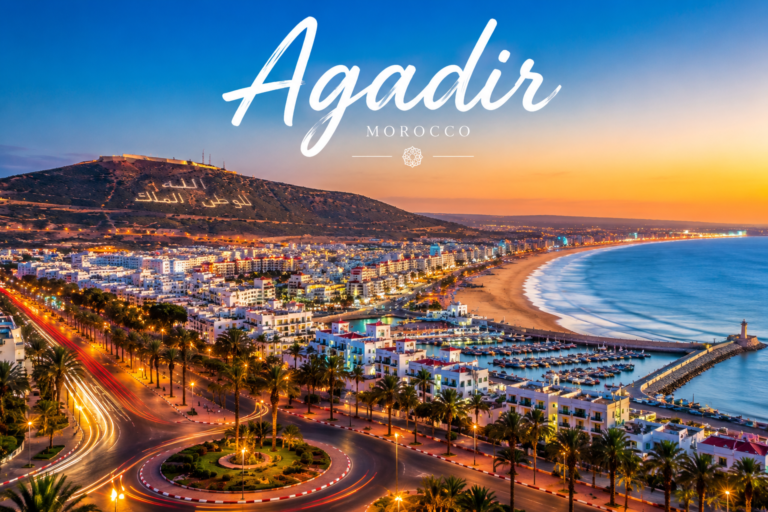
Agadir Morocco: Location, History, Beaches and the Best Things to Do
Agadir is one of Morocco’s most beautiful coastal cities and a wonderful destination for travelers looking for sunshine, beaches, culture, and authentic Moroccan experiences. Located on the Atlantic coast in the southwest of Morocco, Agadir has a different atmosphere from famous imperial cities such as Marrakech and Fes.
With its long sandy beach, palm-lined avenues, nearby mountains, traditional markets, and relaxed atmosphere, Agadir is a great place to spend a few days while exploring southern Morocco.
But Agadir is more than just a beach destination. Behind the modern city is a fascinating history shaped by Amazigh culture, Portuguese influence, earthquakes, and the remarkable rebuilding of the city.
Where Is Agadir Morocco Located?
Agadir is located on Morocco’s Atlantic coast, in the Souss-Massa region of southern Morocco. It sits north of the Souss Valley and is surrounded by the Anti-Atlas Mountains and the High Atlas foothills.
Its location makes Agadir an excellent base for exploring several parts of southern Morocco.
Agadir is approximately:
- 250 km southwest of Marrakech
- 170 km south of Essaouira
- 235 km southwest of Ouarzazate
- 30 km from Taghazout
- about 10 km from Agadir–Al Massira Airport
The city’s coastal position gives it a mild climate for much of the year. This is one reason Agadir is popular with both international visitors and Moroccan travelers.
Its location is also particularly convenient for travelers who want to combine the Atlantic coast, the Anti-Atlas, the Souss Valley, and the Sahara Desert in one Moroccan itinerary.
A Brief History of the City
The history of Agadir goes back many centuries.
The area was traditionally inhabited by Amazigh communities, and the Souss region has long been an important agricultural and commercial area. The name Agadir is an Amazigh word generally associated with a fortified granary or storehouse.
Agadir became increasingly important as a port and trading center. In the 15th and 16th centuries, European powers became interested in the Moroccan Atlantic coast, and the Portuguese established a presence in the area.
The city later developed under Moroccan rule and became an important commercial center for southern Morocco.
However, one event dramatically changed Agadir’s history.
The 1960 Agadir Earthquake
On 29 February 1960, Agadir was struck by a devastating earthquake.
The earthquake lasted only a short time, but its impact was catastrophic. Much of the old city was destroyed, and thousands of people lost their lives.
The old Agadir that existed before the earthquake was largely lost.
After the disaster, Morocco faced the enormous challenge of rebuilding the city. Instead of simply reconstructing the old neighborhoods in the same location, the new Agadir was planned further south and designed as a modern city.
This is one of the most interesting aspects of visiting Agadir today.
When you walk through the modern city, you are walking through a place that was almost completely rebuilt after one of the most important natural disasters in modern Moroccan history.
Agadir Oufella: The Old Fortress Above the City
One of the best places to understand the older history of Agadir is Agadir Oufella, the historic hill overlooking the city and the Atlantic Ocean.
The remains of the old kasbah sit high above Agadir, offering spectacular views over the coastline, harbor, and modern city.
The word “Oufella” means “upper” in Amazigh, which makes sense when you see the location of the fortress.
The climb or drive to the top is worthwhile, especially around sunset. From here, you can appreciate how dramatically Agadir has changed over the centuries.
The hill also provides one of the best panoramic viewpoints in the city.
Agadir Beach
For many visitors, the main attraction is simple: Agadir Beach.
The city has a long, wide sandy beach stretching along the Atlantic coast. The promenade is ideal for walking, enjoying the ocean breeze, having a coffee, or watching the sunset.
Unlike some Moroccan cities where the main attractions are inside historic medinas, Agadir has a more modern and open feeling.
The beach is particularly popular with families, couples, and travelers who want to relax after exploring Morocco.
You can spend the morning visiting the city, enjoy lunch near the coast, and finish the day watching the sun disappear over the Atlantic.
The Agadir Corniche and Marina
The Agadir Corniche is one of the liveliest areas of the city.
The promenade runs along the beach and is filled with cafés, restaurants, hotels, and places to sit and enjoy the ocean views.
Further along the coast, Agadir Marina offers a more modern atmosphere, with restaurants, shops, and boats.
It is a pleasant area to visit in the evening when the temperatures become cooler and the city starts to come alive.
Souk El Had: Discover Agadir’s Local Side
If you want to experience a more traditional side of Agadir, make time for Souk El Had.
This enormous market is one of the city’s best places to experience everyday Moroccan life.
Inside the souk, you can find:
- Fresh fruits and vegetables
- Moroccan spices
- Olives
- Dates and dried fruits
- Argan oil
- Traditional clothing
- Handicrafts
- Leather goods
- Souvenirs
- Household products
The market is not simply a place for tourists. Local residents shop here every day, making it a great place to observe the rhythm of daily life in Agadir.
Take your time, explore the different sections, and don’t be afraid to ask questions.
And, as in many Moroccan souks, friendly bargaining is part of the experience.
Agadir and Argan Oil
Agadir is closely connected to Morocco’s famous argan tree.
The argan tree grows mainly in southwestern Morocco, particularly around the Souss-Massa region and toward Essaouira.
For generations, local Amazigh communities have used argan products for food, traditional cosmetics, and skincare.
Today, visitors can visit women’s cooperatives and learn how argan oil is traditionally produced.
There are two main types of argan oil you may encounter.
Culinary argan oil is produced from roasted kernels and has a distinctive nutty flavor. It can be used in Moroccan cuisine.
Cosmetic argan oil is produced differently and is widely used for skin and hair care.
Visiting a genuine cooperative can be a fascinating cultural experience, especially when you see how much manual work goes into producing the oil.
Taghazout: A Surfer’s Paradise Near Agadir
One of the best day trips from Agadir is Taghazout, a small coastal village located north of the city.
Taghazout is famous internationally for surfing.
The coastline around the village has several well-known surf spots, and the area attracts surfers from around the world.
Even if you don’t surf, Taghazout is worth visiting for its relaxed atmosphere, ocean views, cafés, and beautiful coastline.
It is also an excellent place to combine with an Agadir beach holiday.
Paradise Valley
Another popular excursion from Agadir is Paradise Valley, located in the foothills of the Atlas Mountains.
The valley is known for its rocky landscapes, palm trees, natural pools, and small waterfalls.
The scenery is very different from Agadir’s beaches.
A trip to Paradise Valley gives you the opportunity to leave the city behind and experience the natural landscapes of the surrounding mountains.
The conditions of the natural pools can vary depending on rainfall and the season, so it is always worth checking local conditions before visiting.
Agadir and the Souss-Massa Region
Agadir is the main gateway to the wider Souss-Massa region, an area known for its diverse landscapes and wildlife.
The region includes beaches, agricultural areas, mountains, forests, and protected natural environments.
Nature lovers can explore areas around the Souss-Massa National Park, where different species of birds can be found.
The region is also known for its agriculture. Citrus fruits, vegetables, and other crops are grown extensively in the Souss Valley.
This combination of agriculture, mountains, ocean, and Amazigh heritage gives the region a distinctive identity.
Agadir’s Amazigh Culture
Agadir and the Souss region have strong Amazigh cultural roots.
The Amazigh people have lived in North Africa for thousands of years, and their traditions remain an important part of southern Morocco’s identity.
You can notice Amazigh influence in local architecture, jewelry, carpets, clothing, music, food, and language.
The Tifinagh alphabet, used to write Tamazight, can also be seen on signs and public spaces throughout Morocco.
For travelers interested in Moroccan culture, Agadir provides an excellent opportunity to discover a side of Morocco that is different from the historic imperial cities.
What Food Should You Try in Agadir?
A trip to Agadir would not be complete without trying Moroccan food.
Because Agadir is a coastal city, seafood is particularly popular.
Depending on the season, you can find fresh fish and seafood prepared in simple but delicious ways.
You should also try some Moroccan classics, including:
- Tagine
- Couscous
- Harira
- Moroccan salads
- Grilled meat
- Fresh bread
- Moroccan mint tea
- Amlou
Amlou is particularly associated with southwestern Morocco. It is traditionally made from almonds, argan oil, and honey and is delicious with Moroccan bread for breakfast.
The Best Time to Visit Agadir
One of Agadir’s biggest advantages is its pleasant climate.
The city generally enjoys mild weather compared with many inland Moroccan destinations.
For sightseeing and outdoor activities, spring and autumn are particularly comfortable.
Summer can be warm, but the Atlantic Ocean helps moderate temperatures compared with some inland cities.
Winter can also be an excellent time to visit Agadir if you want to escape colder weather elsewhere. Days are often pleasant, although evenings can be cooler.
If your main goal is surfing, beach activities, or exploring southern Morocco, the best period will depend on exactly what you want to do.
How Many Days Do You Need in Agadir?
For a first visit, 2 to 3 days in Agadir can be enough to see the main attractions and enjoy the beach.
A possible itinerary could look like this:
Day 1: Explore Agadir city, visit Agadir Oufella, walk along the beach, and enjoy the sunset.
Day 2: Visit Souk El Had, explore the marina, and take a trip toward Taghazout.
Day 3: Visit Paradise Valley or explore the wider Souss-Massa region.
However, Agadir can also be used as a base for a longer southern Morocco adventure.
From Agadir to the Sahara Desert
One of the great advantages of Agadir is that it can be included in a larger Morocco itinerary.
From Agadir, travelers can continue toward Ouarzazate, the Draa Valley, Zagora, Merzouga, or the Erg Chebbi dunes, depending on the route and available time.
If your dream is to experience the Sahara Desert, combining Agadir with a desert tour can create a memorable journey through very different landscapes.
You can travel from the Atlantic coast through mountains and valleys before reaching the vast dunes of the Sahara.
With Sahara Desert Crew, you can arrange private and customized Morocco tours starting from Agadir or including Agadir in a longer itinerary. Depending on your interests, your journey can include coastal villages, Amazigh communities, mountain landscapes, kasbahs, oasis valleys, camel trekking, and a night in a Sahara desert camp.
Why Visit Agadir?
Agadir is a destination that offers something different from Morocco’s historic cities.
It combines:
- A beautiful Atlantic beach
- A relaxed coastal atmosphere
- Amazigh culture
- A fascinating modern history
- Traditional Moroccan markets
- Argan oil cooperatives
- Surfing near Taghazout
- Mountain excursions
- Delicious seafood
- Easy access to southern Morocco
Perhaps the most interesting thing about Agadir is the contrast between its past and present.
The old city was devastated by the 1960 earthquake, yet Agadir was rebuilt into one of Morocco’s most modern coastal cities. Today, visitors can enjoy the beach, explore the old kasbah hill, discover local markets, and use the city as a starting point for adventures across southern Morocco.
Final Thoughts: Is Agadir Worth Visiting?
Yes, Agadir is definitely worth visiting, especially if you enjoy beaches, sunshine, outdoor activities, and a more relaxed side of Morocco.
It may not have the same medieval atmosphere as Fes or the colorful souks of Marrakech, but that is precisely what makes Agadir special.
Here, you can enjoy breakfast overlooking the Atlantic, explore a traditional Moroccan souk in the afternoon, watch the sunset from Agadir Oufella, and plan an adventure into the mountains or toward the Sahara the next day.
For travelers exploring Morocco beyond the classic tourist route, Agadir is an excellent stop—and for anyone combining the coast with the desert, it can be the perfect beginning or ending point for an unforgettable Moroccan journey.