
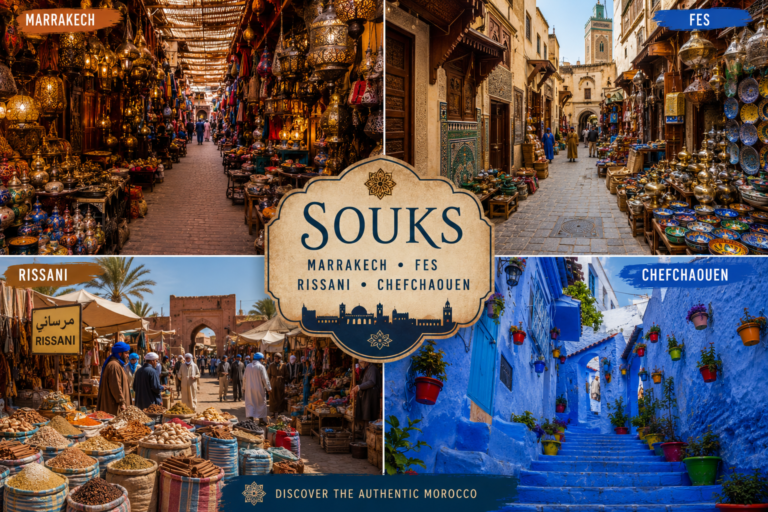
Moroccan Souks: A Complete Guide to Shopping, Culture and Local Life
Moroccan souks are much more than places to shop. They are the beating heart of many Moroccan medinas, where merchants, artisans, locals and travelers meet among narrow streets filled with colors, smells and sounds.
Walking through a Moroccan souk can feel confusing at first. One moment you are looking at handmade carpets, the next you are passing a spice shop, a leather workshop or a small café hidden behind an old doorway.
There is no perfect route through a souk. In fact, getting a little lost is part of the experience.
Whether you are visiting Marrakech, Fes, Chefchaouen, Essaouira or another Moroccan city, exploring the local market gives you an opportunity to see a side of Morocco that you simply cannot experience from a tour bus.
What Is a Moroccan Souk?
A souk is a traditional Moroccan market where people buy, sell and produce a wide variety of goods.
Some souks are huge and spread through entire medinas, while others are smaller neighborhood markets.
Historically, different crafts and products were often concentrated in particular areas. You might find leather workers in one section, metalworkers in another and textile or spice merchants somewhere else.
Today, Moroccan souks continue to serve local communities while also welcoming visitors from around the world.
They are places where traditional craftsmanship meets everyday Moroccan life.
Why Are Moroccan Souks So Special?
One of the best things about Moroccan souks is that they are not museums.
They are alive.
You may see a craftsman working on a piece of leather, a shopkeeper preparing mint tea for a customer, locals buying vegetables for dinner and visitors searching for the perfect souvenir—all within a few minutes.
The atmosphere changes throughout the day.
In the morning, many shops are opening and locals are doing their daily shopping. Later, the narrow streets become busier, and the medina fills with conversations, deliveries, bicycles, scooters and shoppers.
It can be chaotic.
It can also be fascinating.
And once you slow down and stop worrying about finding your way, you begin to appreciate the rhythm of the souk.
The Best Moroccan Souks to Visit
Morocco has many wonderful markets, but several cities are particularly famous for their souks.
Marrakech Souks
The Marrakech souks are among the most famous markets in Morocco.
Located inside the old Medina near Jemaa el-Fna, they form a maze of narrow streets packed with shops and workshops.
You can find almost everything here:
- Moroccan rugs
- Leather bags
- Babouche slippers
- Lanterns
- Spices
- Jewelry
- Ceramics
- Traditional clothing
- Wooden crafts
- Argan oil products
- Decorative items
The souks of Marrakech are particularly good for travelers who want a lively and colorful introduction to Moroccan shopping.
Don’t be surprised if you enter looking for a pair of slippers and leave with a lamp, a leather bag and several kilos of spices.
That is part of the Marrakech experience.
Fes Souks: A Journey Into Traditional Craftsmanship
The souks of Fes offer a different atmosphere.
Fes is famous for its historic medina, where traditional crafts remain an important part of daily life.
One of the highlights is the city’s leather craftsmanship.
The famous tanneries are surrounded by shops selling leather bags, belts, slippers and other handmade products.
Fes is also known for:
- Zellige tilework
- Ceramics
- Metalwork
- Wood carving
- Traditional textiles
- Leather goods
- Handcrafted furniture
Walking through the Fes Medina can feel like stepping into another period of Moroccan history.
The streets are narrow, and many areas are inaccessible to cars. Donkeys and handcarts are still used to transport goods through parts of the old city.
This is one of the reasons why hiring a local guide can make your experience much easier.
Essaouira Souks: Relaxed and Artistic
If the busy atmosphere of Marrakech sounds overwhelming, you may prefer the souks of Essaouira.
Essaouira’s Medina has a more relaxed feeling, with whitewashed buildings, blue doors and a strong connection to the Atlantic coast.
The market is known for:
- Thuya wood products
- Handmade jewelry
- Artwork
- Textiles
- Spices
- Argan oil
- Local crafts
The city is also a good place to look for handmade products without the same intensity you may experience in Marrakech.
After exploring the souks, you can walk toward the harbor, enjoy fresh seafood and watch the fishing boats return to shore.
Chefchaouen: Shopping Among the Blue Streets
Chefchaouen is famous for its blue-painted Medina, but the town also has a charming local market.
Here you can find:
- Woven blankets
- Wool products
- Traditional clothing
- Handmade baskets
- Spices
- Local food products
- Small souvenirs
Shopping in Chefchaouen is as much about the surroundings as the products themselves.
The blue walls, colorful doors and mountain atmosphere make even a simple walk through the market feel special.
What Should You Buy in a Moroccan Souk?
One of the hardest questions is usually:
“What should I buy?”
There are many possibilities, but these are some of the most popular Moroccan products.
1. Moroccan Rugs
Moroccan carpets are among the most sought-after handicrafts.
Styles vary greatly depending on the region and community that made them.
Some are colorful and geometric, while others are simple and neutral.
If you are seriously considering buying a rug, take your time.
Look at several pieces, ask about where they were made and compare prices before making a decision.
A carpet is not something you need to buy in five minutes.
2. Babouche Slippers
Traditional Moroccan babouches are soft leather slippers that come in countless colors and styles.
They are lightweight, easy to pack and make a practical souvenir.
You will find them in almost every major Moroccan souk.
3. Moroccan Lanterns
Colorful Moroccan lanterns can completely change the atmosphere of a room.
You will find metal lanterns in different shapes and sizes, often decorated with intricate patterns.
Just remember to consider how you will transport a larger lantern home before buying one.
4. Spices
Moroccan cuisine is famous for its use of spices.
In the souks, you will often see colorful displays of:
- Saffron
- Cumin
- Paprika
- Turmeric
- Cinnamon
- Ginger
- Ras el hanout
- Dried herbs
The smell of freshly ground spices is one of the most memorable parts of walking through a Moroccan market.
5. Argan Oil
Argan oil is strongly associated with southwestern Morocco.
It is used both in cooking and in cosmetic products.
If you want to buy argan oil, pay attention to the quality and origin rather than simply choosing the cheapest bottle.
For culinary argan oil, look for a product specifically intended for food use.
6. Moroccan Ceramics
Moroccan pottery and ceramics are beautiful souvenirs.
Fes is particularly well known for traditional blue-and-white ceramics and zellige craftsmanship.
You can find plates, bowls, tagines, cups and decorative pieces.
If you are flying home, ask the seller to package fragile items carefully.
7. Leather Goods
Morocco has a long tradition of leather craftsmanship.
You can find:
- Bags
- Wallets
- Belts
- Shoes
- Poufs
- Jackets
Fes and Marrakech are particularly well known for leather products.
Do You Have to Bargain in Moroccan Souks?
Bargaining is a normal part of shopping in many Moroccan souks, particularly for handicrafts and souvenirs.
But don’t treat it like a battle.
The idea is to negotiate respectfully until both sides are comfortable with the price.
A few simple rules can make the experience much more enjoyable.
Ask the price first
Don’t immediately make an offer before knowing the seller’s starting price.
Don’t negotiate if you don’t want to buy
If you have no intention of purchasing something, avoid spending a long time negotiating.
Stay friendly
A smile and a little humor can go a long way.
Don’t worry about getting the absolute lowest price
The goal isn’t necessarily to “win.”
The artisan or shopkeeper needs to make a living, too.
If you agree on a price that feels fair to both sides, you’ve probably had a successful negotiation.
Useful Phrases for Shopping in Morocco
Knowing a few simple words can make shopping more enjoyable.
Salam alaykum — Hello
Shukran — Thank you
Bshhal? — How much?
Ghali Bzzaf — Too expensive
La, shukran — No, thank you
Baraka — Enough / that’s enough
Even trying a few words in Moroccan Arabic, or Darija, often creates a friendlier interaction.
How to Avoid Tourist Traps
Most souk experiences are perfectly enjoyable, but it is worth using common sense.
Be cautious if someone aggressively insists that a particular shop is “the best” or claims that a place is officially recommended when you did not ask for a recommendation.
You may also encounter people offering to show you a “secret” or “special” shop.
Sometimes they are simply trying to earn a commission.
You don’t have to follow anyone.
A polite “La, shukran” is usually enough.
When buying valuable items such as carpets, jewelry or expensive handicrafts, take your time and ask questions about the material, origin and craftsmanship.
Is Shopping in Moroccan Souks Safe?
Moroccan souks are generally busy public areas, but like markets anywhere in the world, visitors should take normal precautions.
Keep your wallet and phone secure, especially in crowded streets.
Avoid displaying large amounts of cash.
If you are carrying a backpack, keep it closed and in front of you in very crowded areas.
Most importantly, don’t let normal souk activity make you nervous.
People calling out to customers, shopkeepers inviting you to look inside and lively bargaining are all part of the traditional market atmosphere.
Should You Visit a Souk With a Guide?
You can explore a Moroccan souk independently, but a local guide can make the experience easier and more meaningful.
A good guide can help you:
- Understand the history of the Medina
- Find traditional artisan workshops
- Communicate with local shopkeepers
- Learn about Moroccan crafts
- Avoid getting completely lost
- Discover places you might otherwise walk past
In Marrakech and Fes especially, the Medina can feel like a maze.
Sometimes the best discoveries happen when you stop following the map.
Moroccan Souks Are About More Than Shopping
Perhaps the biggest mistake a visitor can make is thinking that a souk is simply a shopping center.
It isn’t.
The souk tells you something about Moroccan culture.
You can see how traditional crafts are produced, how people interact with one another and how old commercial traditions continue alongside modern Moroccan life.
A few minutes inside a workshop can sometimes teach you more about Moroccan craftsmanship than reading a page in a guidebook.
Watch the artisan.
Listen to the sounds.
Smell the spices.
Notice the colors.
Talk to people.
And don’t rush.
When Is the Best Time to Visit Moroccan Souks?
The best time depends on the city and season, but mornings are often a pleasant time to explore.
The streets can be quieter, and you can watch shops and workshops opening for the day.
Late afternoon can also be enjoyable, particularly in Marrakech when temperatures begin to fall and the Medina becomes increasingly lively.
During the hottest part of summer, exploring early in the morning or later in the afternoon is generally more comfortable.
Moroccan Souks and Your Morocco Trip
A visit to a Moroccan souk fits naturally into almost any Morocco itinerary.
You could explore the souks of Marrakech before heading into the High Atlas Mountains and continuing toward the Sahara.
Or you could visit the markets of Fes before traveling south toward Merzouga.
You might even combine the experience with a longer Morocco road trip including:
Marrakech → Ait Ben Haddou → Ouarzazate → Dades Valley → Merzouga → Fes
This allows you to experience not only Morocco’s historic cities and souks but also its mountains, valleys, kasbahs and Sahara landscapes.
Final Thoughts: Don’t Be Afraid to Get Lost
Moroccan souks can be overwhelming at first.
The streets are narrow.
The signs aren’t always obvious.
People are calling out from shops.
Scooters pass through places where you didn’t think a scooter could possibly fit.
And you may have absolutely no idea where you are.
But that’s also what makes the experience memorable.
Put the map away for a few minutes.
Follow the smell of spices.
Listen to the sound of a craftsman’s hammer.
Stop for a Moroccan mint tea.
Talk to a local artisan.
And allow yourself to get a little lost.
Because the best memory you take home from a Moroccan souk may not be the souvenir in your suitcase.
It may simply be the memory of walking through a maze of ancient streets and discovering something you never expected to find.
Explore Morocco With Sahara Desert Crew
At Sahara Desert Crew, we believe that discovering Morocco is about more than visiting famous monuments.
Our private Morocco tours allow travelers to experience the country’s cities, mountains, villages, kasbahs, culture and Sahara Desert at a comfortable pace.
Whether you want to explore the souks of Marrakech, discover the ancient Medina of Fes or continue south toward the golden dunes of Merzouga, we can create a Morocco itinerary around your interests and travel dates.
Explore Morocco beyond the usual tourist route and experience the country through its people, landscapes, food and traditions.