
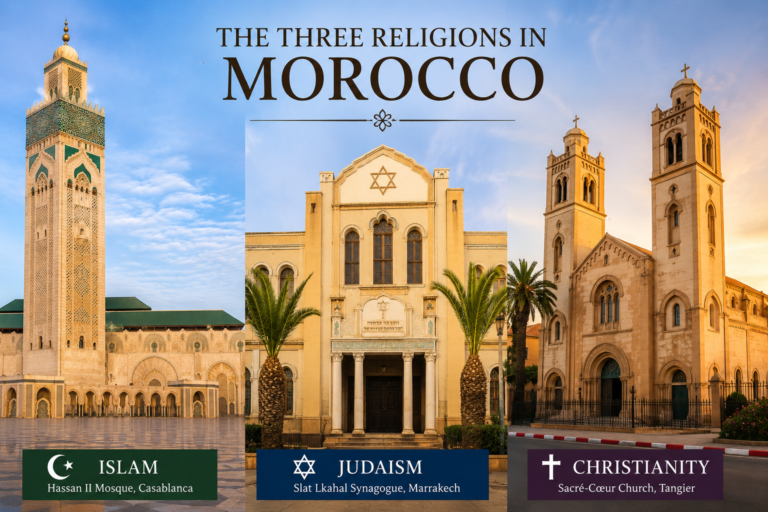
Morocco is one of the most fascinating cultural destinations in North Africa. Travelers often come for the Sahara Desert, imperial cities, Atlas Mountains, and Atlantic coast, but many are also curious about the country’s religious heritage.
So, what religion is practiced in Morocco? The short answer is that Islam is the main religion, practiced by the overwhelming majority of Moroccans. However, Morocco has also been home to Jewish communities for more than 2,000 years and has a small but active Christian community. The country is widely known for its tradition of religious coexistence and tolerance.
In this guide, we’ll explore the history of religions in Morocco, the role of Islam in daily life, Jewish heritage sites, Christianity, and what travelers should know before visiting.
Islam in Morocco
Islam is the official religion of Morocco. Around 90% of the population is Muslim, and most follow the Sunni branch of Islam, specifically the Maliki school of jurisprudence, which has been dominant in the Maghreb for centuries.
The call to prayer
One of the first things visitors notice is the adhan (call to prayer), which is heard from mosque minarets five times a day. The sound becomes part of the atmosphere of cities such as Marrakech, Fes, Meknes, Rabat, and Casablanca.
Friday prayers
Friday is the most important day of the week for Muslims. Around midday, many shops may close temporarily while people attend Jumu’ah (Friday prayer). Tourist areas usually remain active, but it is helpful to plan around this if you are traveling through local neighborhoods.
Ramadan
- Muslims fast from dawn to sunset.
- Cafés and restaurants may have limited daytime service outside tourist zones.
- The atmosphere becomes especially lively after sunset.
- Visitors are not expected to fast, but eating or drinking discreetly in public is appreciated in conservative areas.
If you visit during Ramadan, you’ll experience a unique side of Moroccan culture, with family gatherings, special foods, and evening celebrations.
Can tourists visit mosques in Morocco?

Most mosques in Morocco are reserved for Muslims, and non-Muslims are generally not allowed to enter prayer areas.
The exception: Hassan II Mosque in Casablanca
The most famous exception is the Hassan II Mosque in Casablanca, one of the largest mosques in the world. It offers guided tours for non-Muslim visitors, allowing travelers to admire its incredible architecture, zellige tilework, carved cedar wood, and oceanfront setting.
Respectful behavior near mosques
When visiting mosque surroundings:
- Dress modestly (shoulders and knees covered is recommended).
- Remove shoes only if you are invited inside a permitted area.
- Avoid walking directly in front of people who are praying.
- Ask permission before photographing worshippers.
Judaism in Morocco: A 2,000-Year Heritage

Many travelers are surprised to learn that Morocco has one of the oldest Jewish histories in the Arab world.
Ancient roots
Jewish communities were present in Morocco long before the arrival of Islam in the 7th century. Their numbers increased significantly after 1492, when Jews were expelled from Spain during the Spanish Inquisition. Many found refuge in Moroccan cities, where they contributed to trade, scholarship, music, and craftsmanship.
The Mellah (Jewish quarter)
Traditional Jewish neighborhoods were called Mellahs. You can still visit historic Mellahs in:
- Marrakech Mellah
- Fes el-Jdid Mellah
- Meknes Mellah
- Essaouira Mellah
These areas often contain synagogues, cemeteries, and distinctive architecture.
Synagogues worth visiting
Some of the most important synagogues include:
- Beth-El Synagogue
- Slat Al Fassiyine Synagogue
- Bayt Dakira
Royal protection
Morocco’s Jewish heritage has received strong support from the Moroccan monarchy. Synagogues, cemeteries, and Jewish cultural sites have been restored in recent years, and the country’s constitution recognizes the Hebraic component as part of Moroccan national identity.
For travelers interested in culture and history, a Jewish heritage tour in Morocco can be an excellent addition to a trip that includes Casablanca, Fes, Marrakech, and Essaouira.
Christianity in Morocco
Christianity is a minority religion in Morocco. Most Christians are:
- Foreign residents
- Diplomats
- Migrant communities
- Some Moroccan converts
Historic churches
During the French and Spanish protectorate periods, many churches were built across the country. Notable examples include:
- Sacré-Cœur Cathedral
- Saint Peter’s Cathedral
These buildings are often visited for their architecture rather than for regular worship.
Freedom of worship
Foreign Christians are generally free to practice their religion in churches and private settings. Public proselytizing, however, is restricted under Moroccan law.
Religious Tolerance in Morocco
One of Morocco’s most distinctive features is its long tradition of coexistence between Muslims and Jews. In many cities, synagogues and mosques stood only a few streets apart, and Jewish and Muslim communities shared aspects of language, music, food, and daily life.
The king’s role
The Moroccan king holds the title “Commander of the Faithful” (Amir al-Mu’minin). This role includes responsibility for protecting religious affairs and preserving the country’s tradition of moderation.
The Mohammed VI Institute
Morocco has also invested in training religious scholars and imams through institutions such as the Mohammed VI Institute for the Training of Imams, which promotes a moderate interpretation of Islam and welcomes students from several African and European countries.
What travelers may notice
- Many people pause their activities during prayer times.
- Greetings often include religious expressions such as “Salam Alaikum” (peace be upon you).
- Alcohol is available in licensed hotels, restaurants, and shops, but it is not commonly consumed in public by locals.
- Modest dress is appreciated, especially in rural areas.
Do women need to wear a headscarf?
No. Female tourists are not required to wear a headscarf in Morocco. Many Moroccan women choose to wear the hijab, while others do not. Visitors should simply dress respectfully, particularly when entering religious or traditional areas.
Religious Festivals in Morocco


Islamic festivals
The most important religious celebrations are:
- Ramadan – month of fasting and prayer
- Eid al-Fitr – celebration marking the end of Ramadan
- Eid al-Adha – festival of sacrifice
- Mawlid – celebration of the Prophet Muhammad’s birth
These dates follow the lunar Islamic calendar, so they change each year.
Jewish festivals
Morocco’s Jewish communities also celebrate traditional holidays such as Passover, Rosh Hashanah, and Hanukkah, and some cultural festivals in Essaouira highlight the shared Jewish-Muslim heritage of the city.
Best Places to Explore Morocco’s Religious Heritage
Morocco religious heritage route
Here are the top destinations for travelers interested in Islamic, Jewish, and Christian heritage:
| City | Main religious sites |
|---|---|
| Casablanca | Hassan II Mosque, Beth-El Synagogue, Sacré-Cœur Cathedral |
| Fes | Mellah, Slat Al Fassiyine Synagogue, Qarawiyyin area |
| Marrakech | Koutoubia Mosque exterior, Mellah, Lazama Synagogue |
| Essaouira | Bayt Dakira, historic Mellah |
| Rabat | Hassan Tower, Saint Peter’s Cathedral |
| Meknes | Historic Mellah and old synagogues |
Is Morocco safe for travelers of different religions?
Yes. Morocco is generally considered safe and welcoming for travelers of all religious backgrounds. Millions of visitors from Europe, North America, Asia, and the Middle East travel through the country every year without religious difficulties.
Whether you are Muslim, Christian, Jewish, Hindu, Buddhist, or non-religious, you can comfortably visit Morocco by following a few common-sense guidelines:
- Respect local customs
- Dress modestly in traditional areas
- Avoid criticizing religion in public
- Ask permission before photographing people at religious sites
Moroccans are often curious and friendly, and respectful conversations about culture and religion are usually welcomed.